West Africa’s regional bloc needs up to $2.6 billion annually to establish a 5,000-strong security force to combat terrorism, according to one of the options being considered by defence officials at a meeting on Thursday.
Defence and finance ministers from the Economic Community of West African States (ECOWAS) were meeting in the Nigerian capital Abuja to decide on the size of a potential force and how much would be required to fund it.
Coup-hit West Africa is grappling with a raft of political crises that have hurt regional cooperation. In January, military-ruled Niger, Burkina Faso and Mali decided to exit the 15-member union.
Since 2020, soldiers in the three countries have carried out coups blaming civilian leaders for allowing Islamist militants to gain ground. Once in power, juntas have torn up defence agreements with the U.S., French and U.N. forces and invited Russians to take their place.
Nigerian Defence Minister Mohammed Badaru Abubakar told the meeting that there were two options for a regional force: One which would cost $2.6 billion annually for a brigade of 5,000 and another that would cost $481 million for 1,500 troops.
“These figures underscore the gravity of the task before us,” Abubakar said. “It is therefore imperative that we critically review the options considering the current challenges confronting our region and the financial concerns facing our various members states.”
Abubakar added that the regional force would not be used to reverse coups but limited to fighting terrorism. Each member state would be expected to contribute a quota, he said.
ECOWAS commission president Omar Touray said members under suspension would not be excluded from the regional force.
“It is believed we cannot fight terrorism alone while others are not participating,” Touray said.
“Although, other countries might be under suspension but they should be allowed to take part in meetings related to security, that is why we have invited all 15 member states to attend this crucial meeting.”
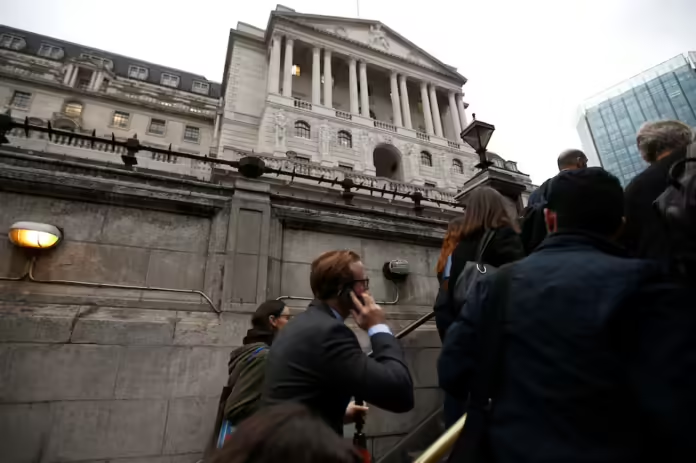
Risk management in the private equity sector needs improving, the Bank of England said on Thursday, particularly as the period of low interest rates ends and leads to higher financing costs for risky debt in a highly leveraged industry.
The BoE said in its twice-yearly Financial Stability Report, opens new tab that an investigation of the sector showed “vulnerabilities” and challenges from higher borrowing costs.
The BoE’s report is the latest sign of how regulators globally are increasing scrutiny of the rapidly growing non-bank and market based finance, now accounting for about half of global financial assets, and their links to banks.
PE backed companies account for 5% of UK private sector revenues, 10% of private sector jobs or more than 2 million employees, the BoE said.
Vulnerabilities include “multiple layers of leverage” and strong links with riskier credit markets, with “opaque” valuation and risk management practices, it added.
“Improved transparency over valuation practices and overall levels of leverage would help reduce the vulnerabilities in the sector,” the BoE said. “Risk management practices in some parts of the sector need to improve, including among lenders to the sector such as banks.”
Private equity industry body the BVCA said many of the BoE concerns are already being addressed by the Financial Conduct Authority, and it was “highly engaged in these processes”.
The BoE’s Financial Policy Committee said it would consider the results of work being done internally and by the FCA to address some of these problems.
BANK VALUATIONS
The report also looked at stock market valuations of British banks after concern from Britain’s Conservative government that they had been lagging those of U.S. rivals. But the BoE found that valuations were in line with euro zone peers and had begun closing the gap with the United States.
“The difference in banking sector equity valuation in the UK relative to the U.S. is similar to that of other economic sectors,” the report said. Market-wide factors, such as differences in economic outlooks and “market depth” were significant drivers of bank valuations in Britain, it added.
“The FPC will continue to monitor developments in UK banks’ market valuations, including in comparison with international peers,” the BoE said.
The BoE said it would also undertake a “desk based” stress test of Britain’s major banks this year, meaning it would use its own models rather than requesting data from them. Aggregate results would come in the fourth quarter. A standard stress test with individual results is anticipated in 2025.
The UK banking sector had the capacity to support households and businesses, even if economic and financial conditions were to be substantially worse than expected, the FSR said.
The so-called countercyclical capital buffer (CcyB), or ‘rainy day’ buffer on banks that can be drawn on in stressed times, remains at its neutral setting of 2%, the BoE said.
It also set out the initial findings of its first system-wide exploratory scenario or SWES, which tested the impact of theoretical shocks affecting different market participants on the UK government bond market.
So far the SWES test showed that liquidity needs rose significantly as ‘margin’ for backing positions increased, with selling in corporate bonds also rising.
After the near-meltdown in the UK government bond market in September 2022, liquidity buffers of market participants are now well above regulatory minimum levels.
A second leg of the test is now being rolled out with overall results published in the fourth quarter, helping to shape regulation going forward.
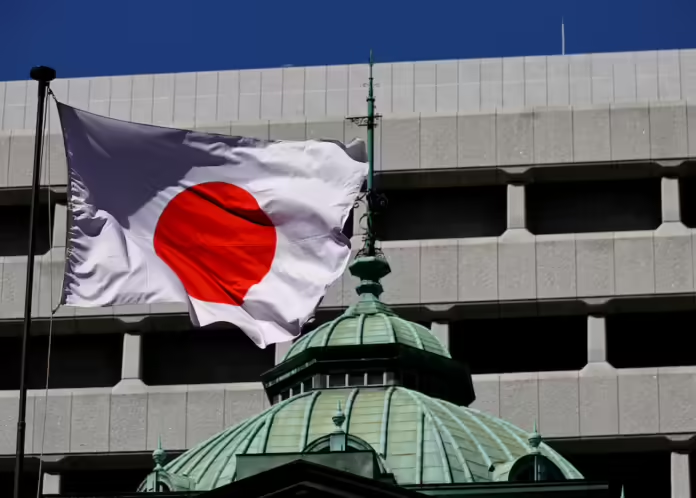
The Bank of Japan is conducting a survey of Japanese government bond market participants over the central bank’s bond-tapering plans, three sources familiar with the matter said on Thursday.
The survey is expected to be used as a basis for discussions at the BOJ’s meetings with bond market participants on July 9-10, said the sources, who declined to be identified as the matter is private.
The BOJ decided to start tapering its huge bond buying and reduce its holdings which, at 589 trillion yen ($3.7 trillion), make up roughly half of total Japanese government bonds (JGB) sold in the market.
It has said it would hold the meetings with bond market participants before deciding details on how it plans to reduce its huge bond purchases in the next one to two years.
The survey is asking the market participants, including banks, brokerage houses and life insurers, about their expectations over the range and pace of tapering, the sources said.
Asked by Reuters, the BOJ confirmed it is contacting all the participants of the upcoming meetings to collect their views on the amount, pace and framework for the planned reductions.
The diminishing presence of the BOJ heightens the need for the government to find stable buyers of JGBs and avoid a bond selloff that could trigger a damaging spike in yields.
A finance ministry panel has called for an environment where government bonds remain an attractive investment for financial institutions, such as by issuing shorter-duration debt.
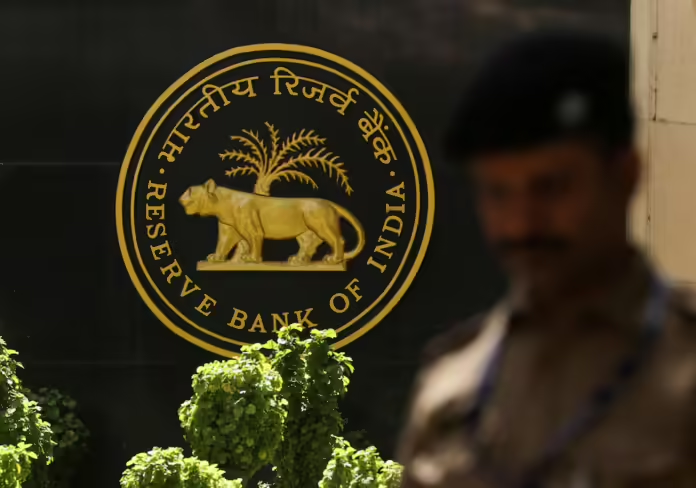
A rapid rise in derivative trading volumes in India could pose several challenges, a central bank report said on Thursday, adding to warnings of the financial stability risks that could emerge from a surge in retail participation in the country’s futures and options market.
Retail investors could be exposed to sudden movements in markets without proper risk management if they have large exposure to derivatives, the Reserve Bank of India said in the Financial Stability Report, which is a collective assessment of India’s Financial Stability and Development Council and includes contributions from all key regulators.
“Since derivatives are more complex than the underlying, investor protection is a key regulatory imperative,” the report said.
The comments follow a warning from India’s federal Finance Minister Nirmala Sitharaman, who said last month that an unchecked explosion in retail trading of futures and options can create future challenges not just for the markets, but also for investor sentiment and household finances.
Markets regulator the Securities and Exchange Board of India (SEBI) is mulling several changes to its derivative trading rules, Reuters reported earlier this month.
SEBI has set up a committee to review the futures and options market from both an investor protection and overall systemic risk management perspective, the report said.
In particular, the surge in shorter-duration options could lead to more volatility in the stock market, the report said.
“The preference among investors to reduce holding period and shift from one instrument to another searching for immediate expiries could intensify volatility,” it said.
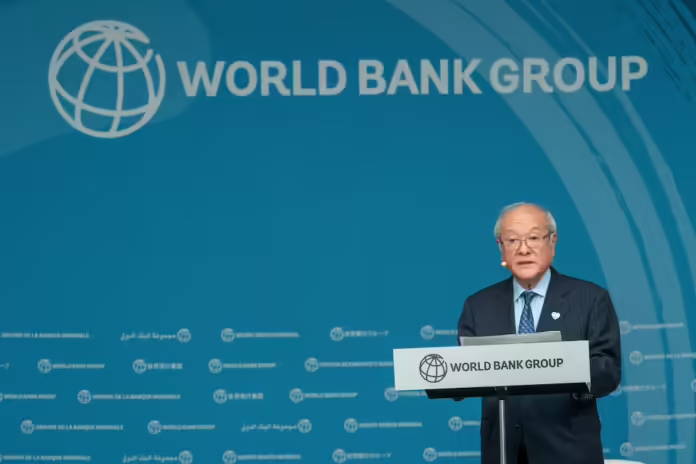
Japanese authorities will take necessary actions on currencies, Finance Minister Shunichi Suzuki said on Thursday, signalling readiness to intervene in the exchange-rate market after the yen’s slide to a fresh 38-year low against the dollar.
“It’s desirable for exchange rates to move stably. Rapid, one-sided moves are undesirable. In particular, we’re deeply concerned about the effect on the economy,” Suzuki told reporters.
“We are watching moves with a high sense of urgency, analysing the factors behind the moves, and will take necessary actions,” he said.
Chief Cabinet Secretary Yoshimasa Hayashi also told a news conference on Thursday that Tokyo will take “appropriate” action against excessive currency moves. He declined to comment on yen levels and whether authorities would intervene.
The yen stood at 160.52 per dollar on Thursday, remaining a fraction away from the 38-year low of 160.88 hit on Wednesday.
Japanese authorities are facing renewed pressure to combat sharp declines in the yen, which has fallen 12% so far this year against the dollar as traders focus on the wide interest rate divergence between Japan and the United States.
The yen’s fast-pitch decline below the key 160-to-the-dollar level is heightening market alarm over the chance of imminent yen-buying intervention.
“At this point, authorities are probably starting to worry not just about the speed but the level,” Masafumi Yamamoto, chief currency strategist at Mizuho Securities, said in a research note. “Unless they intervene, there’s a risk the yen will slide toward 162.”
But analysts doubt whether jawboning, and even intervention, can reverse the weak-yen tide that is driven mostly by uncertainty over how soon the U.S. Federal Reserve will start cutting interest rates.
The Bank of Japan has dropped signals of an imminent interest rate hike, though any increase in the current near-zero short-term policy target will still keep Japan’s borrowing costs very low.
Still, the yen’s slide could heighten pressure on the BOJ to accompany a scheduled announcement of a quantitative tightening (QT) plan with a rate hike at its next policy meeting on July 30-31, some analysts say.
Speaking after a meeting to approve the government’s monthly economic report, Economy Minister Yoshitaka Shindo said on Thursday that policymakers must be vigilant to the risk of a soft yen pushing up inflation through rising import costs.
“A weak yen is among factors that push up inflation, so we will closely watch the currency’s moves in guiding monetary policy,” BOJ Deputy Governor Shinichi Uchida was quoted as saying at the meeting, according to a Cabinet Office official who briefed reporters on the discussions.
Tokyo spent 9.8 trillion yen ($61 billion) intervening in the foreign exchange market at the end of April and early May, after the Japanese currency hit a 34-year low of 160.245 per dollar on April 29.
Artificial intelligence promises to help banks with two things they produce in abundance: profit and paperwork. The rapidly developing technology should help boost the first and reduce the second. For such a seismic and seemingly universal force for financial good, however, there’s little tangible sign yet that shareholders believe in the prospective value uplift for the industry.
More efficient lenders ought to be an easy sell to anyone who has endured excruciating loan application processes or been stuck at a store with a credit card mistakenly declined for suspected fraud. Generative AI, which produces human-friendly discourse from existing information, is on track to improve support for customers and pitch them suitable products. On the inside, it can do something similar, allowing employees to efficiently extract rapid and useful insights from mountains of unstructured data such as mortgage agreements and meeting notes. If that’s possible, as bank CEOs and software engineers generally agree, then financial institutions should theoretically be more attractive investments, too.
All the people and time spent churning out and sifting through documentation adds up to huge amounts of money. The bottom lines of banks worldwide could rise by 9%, or $170 billion, by 2028 thanks to generative AI, Citigroup analysts estimate, opens new tab based on a poll of financial-sector clients. A study from consulting firm, opens new tab McKinsey came up with a similar sum, between $200 billion and $340 billion, with the biggest impact in software engineering and customer-facing businesses.
Large numbers are only helpful up to a point, because of AI’s sprawling effects. JPMorgan (JPM.N), opens new tab boss Jamie Dimon said, opens new tab last month that AI could assist across his mega-bank, from travel plans to equity trading, and would basically “blow people’s minds.” His Morgan Stanley (MS.N), opens new tab counterpart, Ted Pick, says tools such as a Zoom-embedded assistant that creates client meeting summaries for wealth managers could save them up to 15 hours a week, and are “game-changing.”
More tangible examples are also starting to emerge. JPMorgan has rolled out IndexGPT, a bot for big funds that uses keywords to suggest stocks to go with investment themes. Bank of America’s (BAC.N), opens new tab AI retail-bank assistant, Erica, is being introduced to business customers. Goldman Sachs (GS.N), opens new tab is prioritizing code-writing, which consumes up to half the working day for a quarter of its staff.
Even a sophisticated chatbot would struggle to explain why bank investors are unmoved by the hype. The S&P 500 Index (.SPX), opens new tab owes most of its 15% increase this year to the so-called Magnificent Seven group of AI-fueled stocks, led by chipmaker Nvidia (NVDA.O), opens new tab. An exchange-traded fund that tracks, opens new tab such companies is up more than 30% compared to just 6% for the KBW Nasdaq Banks Index. The banking sector overall trades at just 0.9 times estimated year-ahead book value, according to LSEG data, hardly indicative of a mind-blowing transformation.
Reuters Graphics
One reason is that AI is still mostly about potential. JPMorgan says it has 400 “use cases” already, a number that might double by the end of 2024, but there isn’t much shareholders can do with that information. It’s no coincidence that some of the biggest AI beneficiaries so far are consultants. Accenture (ACN.N), opens new tabhas booked, opens new tab $2 billion of contracts over the past three fiscal quarters alone on fees related to generative AI.
While banks might in theory benefit from the technology more than many other non-financial companies, they also have a lot to lose. Mistakes can be dire where trillions of dollars are held. Citigroup’s (C.N), opens new tab fat-finger errors, including the accidental trigger, opens new tab of a $444 billion stock trade, exemplifies the value of AI that can spot slips and hints at the fallibility of the people who would be overseeing it. Algorithms might make mistakes, but regulators and litigious stakeholders will blame humans.
Investors, meanwhile, are zeroing in on potential savings. At Citi, boss Jane Fraser is making it her mission to “bend the expense curve.” For all the efficiency drives and technological advances, however, expenses at the biggest U.S. banks eat up 59% of revenue on a four-quarter average basis, the same proportion as in 2007, according to Federal Deposit Insurance Corp data.
Machine learning should help, but will hurt first. For each $1, opens new tab spent on generative AI, there’s a further $3 deployed on “change management,” such as retraining staff or monitoring performance, McKinsey reckons. Dimon has warned that costs will go up, and that in some cases trying to measure the return will be a “waste of time.”
For now, costs are modest. Bank of America Chief Executive Brian Moynihan said last year that AI would probably account for roughly 15% of the $3.8 billion his lender spends each year on new technology initiatives, which is in turn around one-third of its total technology budget. Apply the same ratios to JPMorgan’s $17 billion tech allotment and it suggests the AI tab will be less than $1 billion.
Even when results do appear, there are good reasons for investors to be skeptical about how much they’ll benefit. Banks ought to be more predictable and dependable as they get better at, say, sidestepping fraud and avoiding regulatory penalties. Many of the AI-related dividends, however, will be passed onto customers, as big lenders compete to win business from each other.
Moreover, customers themselves are likely to get smarter. One example: Depositors rarely switch lenders, even when there’s a far better offer elsewhere, evidenced by the 17-year duration of the average U.S. retail-account relationship, according to personal finance website Bankrate. They might flee more readily if armed with real-time information, along with AI-powered instructions and processing capabilities. It would make bank funding models look very different.
The same could be true of credit cards, a business that’s lucrative partly because customers overestimate their ability to pay on time and overvalue opaque rewards. Wealth management also might be changed, as much of its value derives from information asymmetries between service providers and recipients. In a world of smart bots, the premia banks charge for such advice could shrink.
Years from now, AI will be everywhere in banking, and its value will be just as hard to quantify as other ubiquitous technology. Smartphones, electronic spreadsheets and online trading all have changed banking for the better. But with such opportunities comes understandable anxiety that capital will be misallocated, people will keep erring and gains will be competed away. The advent of generative AI might turn out to be banks grabbing a tiger by the tail.
A look at the day ahead in European and global markets from Tom Westbrook
So much for a week watching football and cricket while counting down to Friday’s blockbuster U.S. personal consumption price index.
The waiting has turned bumpy following unnerving inflation surprises in Canada and Australia, a slump in the yen and a negative reaction to solid results at Micron(MU.O), opens new tab.
Shares in the chipmaker, seen as an industry bellwether due to its exposure to varied chip types and customers, slid 8% in after-hours trade and dragged down Nasdaq futures .
Australia’s bond market has taken a kicking, with three-year government bond futures down 26 ticks in two sessions as the risk of another rate hike climbs. Aussie bank stocks dropped in anticipation of economic pain and bond proxies from utilities to real estate were punished beyond ex-dividend selling.
The pace of expected rate cuts in Canada has pared back.
The yen, meanwhile, skidded to lifetime lows on the euro and its lowest since 1986 at 160.88 per dollar on Wednesday, hovering near those levels in the Asia session while Japan’s finance minister reiterated concern.
The yen is down about 12% on the dollar this year, the biggest fall of any G10 currency, driven mostly by the wide gap between U.S. interest rates – above 5% at the short end – and Japanese rates which are around zero.
Euro zone confidence, services and economic sentiment surveys are due on Thursday, as is final U.S. GDP data, though both are likely to be overshadowed by the PCE reading, the Federal Reserve’s preferred inflation measure due on Friday.
CNN also broadcasts the first U.S. presidential debate, where debt and the dollar are likely to feature in the discussion, though markets have thus far struggled to come to grips with the implications of November’s election outcome.
Joe Biden and Donald Trump will have their microphones muted when it is not their turn to talk.
Voters see Republican candidate Trump as better for the economy but prefer his Democratic rival President Biden’s approach on preserving democracy, a new Reuters/Ipsos poll found. In swing states, however, according to a Washington Post, opens new tab poll, more voters trust Trump to safeguard democracy.
How do you price that in?
Reuters Graphics
Key developments that could influence markets on Thursday:
A jury on Thursday convicted Donald Trump of falsifying business records to conceal hush money paid to porn star Stormy Daniels before the 2016 election.
Bragg’s office last year charged Trump with 34 counts of falsifying business records to cover up a $130,000 payment that Trump’s former personal lawyer and fixer Michael Cohen made to Stormy Daniels, whose given name is Stephanie Clifford. The payment was made in the waning days of the 2016 campaign in exchange for her silence about a sexual encounter she says she had with Trump a decade earlier, prosecutors said.
Prosecutors have alleged that was part of a broader “catch-and-kill” scheme to suppress negative news stories about Trump before the 2016 election in which Trump defeated Democrat Hillary Clinton.
Cohen has also said he and Trump discussed a $150,000 payment made by American Media, publisher of the National Enquirer tabloid, to former Playboy model Karen McDougal to keep quiet about an affair she says she had with Trump. The tabloid never published a story.
Trump denies both sexual relationships and has called the case a politically motivated “witch hunt.” Trump in 2018 admitted to reimbursing Cohen for his payment to Daniels, though his lawyers have since argued that his payments to Cohen in 2017 were retainer payments for Cohen’s work as his personal lawyer that year, not reimbursements for the Daniels payment.
WHAT LAWS WAS TRUMP ACCUSED OF VIOLATING?
According to prosecutors, Trump disguised his 2017 reimbursement checks to Cohen for the Daniels payment as retainer fees for legal services in records maintained by his New York-based family real estate company, the Trump Organization.
Each of the 34 counts stem from a check, ledger entry or invoice from Trump’s payments to Cohen.
It is against New York state law to make a false entry, opens new tab in a company’s records. While falsification of business records on its own is a misdemeanor, it is considered a felony punishable by up to four years in prison if it is done to conceal or further other crimes.
In this case, Bragg said that other crime was a violation of a New York state law making it a misdemeanor to conspire to promote a candidacy by “unlawful means.” Prosecutors say Trump, Cohen, and former American Media chief executive David Pecker conspired to pay off people with potentially negative stories about Trump – including Daniels – to remain quiet before the 2016 election. They say those payments were effectively campaign contributions that exceeded the $2,700 cap on individual donations in 2016.
HOW DID TRUMP PAY COHEN?
Jurors saw 11 checks from Trump or his trust to Cohen in 2017 that totaled $420,000.
Prosecutors say that included reimbursements for the Daniels payment and $50,000 for other expenses Cohen incurred while working on Trump’s campaign, as well as $180,000 to account for taxes Cohen would have had to pay for falsely reporting the money as income rather than a reimbursement, according to prosecutors.
The checks also included a $60,000 bonus for Cohen’s work for the Trump Organization, prosecutors said.
WHAT WAS TRUMP’S DEFENSE?
Trump’s lawyers argued that Cohen acted on his own when paying Daniels, and that the purpose of silencing Daniels and McDougal was to spare him and his family the embarrassment of public attention to alleged extramarital affairs, not to help his campaign. They have also said that his payments to Cohen in 2017 were legal retainer fees.
They sought to undercut Cohen’s credibility as a witness, by pointing out that he perjured himself before Congress, pleaded guilty to federal crimes, and frequently stated publicly that he wants to see Trump punished.
Cohen pleaded guilty in 2018 to violating federal campaign finance laws through the hush money scheme. The U.S. Attorney’s office in Manhattan never charged Trump, whom it referred to in its charging document against Cohen as “Individual-1,” with any crime.
In an interview with Reuters in December 2018, Trump said the payment to Daniels “wasn’t a campaign contribution” and “there was no violation based on what we did.”
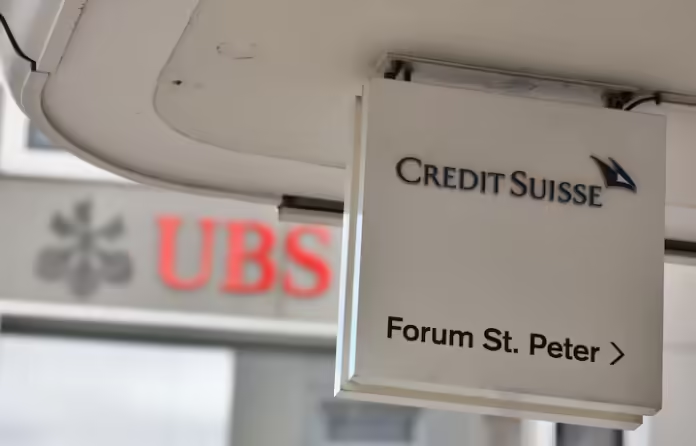
UBS (UBSG.S), opens new tab on Friday completed the merger of the main parent companies of the Swiss bank and Credit Suisse, which it acquired last year after its longtime rival collapsed, putting an end to one of the bastions of the country’s financial sector.
Shares in UBS ticked upwards after the business announced it had succeeded to all the rights and obligations of Credit Suisse, including all outstanding Credit Suisse debt instruments, and were trading up by 1.35% at around 1106 GMT.
The merger concluded within the planned timeline and was facilitated by strong support from global regulators, said UBS, whose shares have jumped about two-thirds since it snapped up Credit Suisse for 3 billion Swiss francs ($3.3 billion).
The parent merger is expected to allow the Swiss bank to get started with trickier stages of the integration such as combining IT systems, migrating clients from Credit Suisse and cutting the enlarged bank’s workforce of more than 110,000.
UBS CEO Sergio Ermotti said the merger was a “significant milestone” in the integration, which would be crucial to facilitating the migration of clients onto UBS platforms.
“It will also unlock the next phase of cost, capital, funding and tax benefits from the second half of 2024,” he said.
The step follows a shake-up in the executive board of the bank announced on Thursday which will split its top wealth management role, carving out new responsibilities for two leading contenders to run the bank after Ermotti.
The UBS absorption of Credit Suisse has left Switzerland with a single global bank, one boasting a balance sheet around twice the size of the country’s annual economic output.
That has stirred fears of the potential damage that any problems at UBS could cause for Switzerland, and prompted the government to set about crafting measures aimed at containing the risk of a bank that is deemed “too big to fail” (TBTF).
Shares in UBS took a knock after the government laid out its TBTF proposals early last month. But they later recovered and at around 28.5 per share, they are now trading higher than they were before the government unveiled the plan.
In its statement, UBS said the transition to a single U.S. intermediate holding company is planned for June 7, and that the merger of Credit Suisse Switzerland and UBS Switzerland is still expected to occur in the third quarter of 2024.
China has provided more than 2.3 billion yuan ($316.4 million) in funds to help with rescue efforts, emergency supplies and planning as deadly floods and landslides caused by almost two weeks of torrential rain ravage several parts of the country.
Various government departments have allocated 2.344 billion yuan, according to Reuters calculations, to various cities and provinces over the past several days to help with rescue efforts, planning and relocating those affected.
On Thursday, the Ministry of Finance and the Ministry of Emergency Management, issued 496 million yuan – the latest tranche in natural disaster relief funds – for the provinces of Zhejiang, Anhui, Fujian, Jiangxi, Hubei, Hunan, Guizhou, and Guangdong, and Guangxi region, CCTV news said.
Last week, President Xi Jinping urged authorities to put in all-out efforts to protect lives as floods and natural disasters increased.
Dozens of people have died from floods or rain-induced landslides during the annual flooding season, with southern China getting hit particularly hard this year.
The persistent torrential rain has forced authorities across municipalities to ramp up emergency plans as swollen rivers threaten the lives of millions.
Heavy rain in cities and areas near the Yangtze River Basin have caused surrounding waterways to reach dangerous levels.
On Thursday, officials in Jiangxi warned that the water levels of some rivers and lakes in the northern part of the province had risen rapidly due to heavy rain and could flood, while moist soil in mountainous areas is saturated, which could cause landslides, according to Xinhua news.
In Changsha, the capital of Hunan, the Xiang and Laodao rivers are expected to hit peak dangerous levels Thursday morning, state media reported.
This Monday, heavy rain in the southern Chinese city, turned roads into rivers and submerged pedestrian underpasses and subway tunnels.