Israel’s hard-line finance minister said on Thursday that the government would promote West Bank settlements and punitive measures against the Palestinian Authority in response to Palestinian moves against Israel on the international stage.
Finance Minister Bezalel Smotrich, who heads a pro-settler party, said in a statement that the government supported his proposal.
Prime Minister Benjamin Netanyahu’s office, which usually announces cabinet-level decisions, did not issue any statements and was not reachable for immediate comment.
Among the steps Smotrich said he was advancing was the revoking of “various approvals and benefits” for senior officials in the Palestinian Authority, approving new settlement buildings, and retroactively sanctioning some Jewish settlements.
Packed into a small room, a drone, bipedal robot, supermarket checkout and other devices showcase a vision of China’s software future – one where an operating system developed by national champion Huawei has replaced Windows and Android.
The collection is at the Harmony Ecosystem Innovation Centre in the southern city of Shenzhen, a local government-owned entity that encourages authorities, companies and hardware makers to develop software using OpenHarmony, an open-source version of the operating system Huawei launched five years ago after U.S. sanctions cut off support for Google’s (GOOGL.O), opens new tab Android.
While Huawei’s recent strong-selling smartphone launches have been closely watched for signs of advances in China’s chip supply chain, the company has also quietly built up expertise in sectors crucial to Beijing’s vision of technology self-sufficiency from operating systems to in-vehicle software.
President Xi Jinping last year told the Communist Party’s elite politburo that China must wage a difficult battle to localise operating systems and other technology “as soon as possible” as the U.S. cracks down on exports of advanced chips and other components.
OpenHarmony is now being widely promoted within China as a “national operating system” amid concerns that other major companies could be severed from the Microsoft (MSFT.O), opens new tab Windows and Android products upon which many systems rely.
“This strategic move will likely erode the market share of Western operating systems like Android and Windows in China, as local products gain traction,” said Sunny Cheung, an associate fellow at the Jamestown Foundation, a U.S. defence policy group.
In the first quarter of 2024, Huawei’s HarmonyOS, the company’s in-house version of the operating system, surpassed Apple’s (AAPL.O), opens new tab iOS to become the second best-selling mobile operating system in China behind Android, research firm Counterpoint said. It has not been launched on smartphones outside China.
Huawei no longer controls OpenHarmony, having gifted its source code to a non-profit called the OpenAtom Foundation in 2020 and 2021, according to an internal memo and other releases.
But both the innovation centre and government documents often refer to OpenHarmony and HarmonyOS interchangeably as part of a broader Harmony ecosystem. The growth of HarmonyOS, expected to be rolled out in a PC version this year or next, will spur adoption of OpenHarmony, analysts said.
“Harmony has created a powerful foundational operating system for the future of China’s devices,” said Richard Yu, the chairman of Huawei’s consumer business group, at the opening of a developer conference last week.
Huawei did not respond to a request for further comment.
SELF-SUFFICIENCY
Huawei first unveiled Harmony in August 2019, three months after Washington placed it under trade restrictions over alleged security concerns. Huawei denies its equipment poses a risk.
Since then, China has stepped up its self-sufficiency efforts, cutting itself off from the main code sharing hub Github and championing a local version, Gitee.
China banned the use of Windows on government computers in 2014 and they now use mostly Linux-based operating systems.
Microsoft earns only about 1.5% of its revenue from China, its president said this month.
Originally built on an open source Android system, this year Huawei launched its first “pure” version of HarmonyOS that no longer supports Android-based apps, in a move that further bifurcates China’s app ecosystem from the rest of the world.
A report from the Jamestown Foundation last month said OpenHarmony’s owner OpenAtom appeared to be coordinating efforts among Chinese firms to develop a viable alternative to U.S. technologies, including for defence applications such as satellites.
Beijing-based OpenAtom did not respond to a request for comment.
OPEN SOURCE
OpenHarmony was the fastest-growing open-source operating system for smart devices last year, with more than 70 organisations contributing to it and more than 460 hardware and software products built across finance, education, aerospace and industry, Huawei said in its 2023 annual report.
The aim of making it open source is to replicate Android’s success in removing licensing costs for users and to give companies a customisable springboard for their own products, said Charlie Cheng, deputy manager of the Harmony Ecosystem Innovation Centre, when Reuters visited.
“Harmony will definitely grow into a mainstream operating system, and will give the world a new choice of operating system besides iOS and Android,” he said. “China is learning from the West.”
Google, Apple and Microsoft did not respond to requests for comment.
The Harmony ecosystem has seen strong support from Huawei’s home city of Shenzhen, a city historically used as a trial site for policies later adopted across China.
Along with a Harmony centre that opened in the southwestern city of Chengdu, 10 more are expected in a further 10 cities, according to a Shenzhen centre presentation.
Key OpenHarmony developers include Shenzhen Kaihong Digital, headed by Wang Chenglu, a former Huawei employee known as Harmony’s “godfather”, and Chinasoft (0354.HK), opens new tab. Both have worked on infrastructure software, at Tianjin Port and for mines in China’s top coal-producing province Shaanxi.
While OpenHarmony is largely confined to China, Brussels-based open-source group the Eclipse Foundation said it was using it to develop a system called Oniro for use in mobile phones and internet-of-things devices.
China’s previous efforts to build major open-source projects have struggled to gain traction among developers, but Huawei’s growing smartphone market share and extra work to develop a broader ecosystem gives Harmony an advantage, analysts said.
More than 900 million devices, including smartphones, watches and car systems are running on HarmonyOS, while 2.4 million developers were coding in the ecosystem, Huawei’s Yu said this month.
“OpenHarmony will need more time and iterations so that these developers will be more confident to work with OpenHarmony,” said Emma Xu, an analyst with research firm Canalys. “But the reputation, behaviour and confidence that HarmonyOS has achieved will definitely bring a positive effect.”
Japanese Finance Minister Shunichi Suzuki said on Friday that the authorities were “deeply concerned” about the impact of “rapid and one-sided” foreign exchange moves on the economy, as the yen declined to 38-year lows past 161 per dollar.
Speaking at a regular press conference, Suzuki said authorities would respond appropriately to excessive currency moves and that confidence in the Japanese currency is maintained.
“The government is closely monitoring developments in the foreign exchange market with a high sense of urgency,” Suzuki said, adding efforts to continue forging ahead with fiscal reform is crucial.
The yen fell to its weakest since 1986 at 161.155 per dollar on Friday morning, with neither an overnight drop in U.S. yields nor data showing solid consumer price gains in Tokyo arresting the downward slide in Japan’s currency.
Finance ministry officials have been ramping up warnings against the sliding yen this week, signalling readiness to intervene in the currency market.
Japanese authorities are facing renewed pressure to stem sharp declines in the yen as traders focus on the interest rate divergence between Japan and the United States.
Tokyo spent 9.8 trillion yen ($60.91 billion) intervening in the foreign exchange market at the end of April and early May, after the Japanese currency hit a then 34-year low of 160.245 per dollar on April 29.
UBS (UBSG.S), opens new tab is shaking up its wealth-management arm, the bank’s flagship business, to boost its offerings to ultra-rich clients, the division’s new co-leaders said in their first internal memo sent on Thursday and seen by Reuters.
UBS will create a new unit from July 1, named GWM Solutions, to integrate various client offerings, such as investment management, lending, family and institutional wealth management and alternative investments, the memo from Rob Karofsky and Iqbal Khan said.
The unit will be led by former Credit Suisse banker Yves-Alain Sommerhalder who will be based in Zurich and New York and report to Karofsky and Khan.
In a separate memo, the bank said it was creating a unit called “Unified Global Alternatives,” shifting some of its alternative asset-management products closer to its wealth arm.
The new unit will incorporate alternative products from its wealth and asset management businesses, including real estate and private market investments.
Reuters reported in May that UBS was considering whether parts of the asset-management unit should be absorbed by its larger wealth-management activities as the bank aimed to cut costs.
Wealth management is UBS’ flagship business, making up more than half of total revenues at the Swiss bank, which last year took over Credit Suisse in a state-sponsored rescue and is in the process of integrating its former rival.
Last month, UBS said it would split its top wealth-management role, creating new responsibilities for Karofsky and Khan as two leading contenders to eventually succeed CEO Sergio Ermotti.
In a further move, Latin America will become its own business unit led by Marcello Chilov, Credit Suisse’s former chief executive officer in Brazil.
In the United States, JPMorgan banker Michael Camacho will join UBS as head of U.S. global wealth management, starting Sept. 16.
The U.S. Treasury and the U.S. Agency for International Development are calling leaders of multilateral development banks into an urgent meeting on extreme heat and its devastating impact on developing countries, according to Treasury officials.
The private, virtual meeting on Thursday morning – the first of its kind – is aimed at finding ways to shift more resources to help countries build climate resilience and adaptation to reduce extreme heat damage amid a summer of record temperatures globally, the Treasury officials told Reuters.
While investments to fight climate change have increased dramatically in recent years, much of that growth has gone towards the transition to clean energy sources and reducing carbon emissions, not in helping countries adapt to the harmful impacts, including more severe droughts, wildfires, violent storms and rising ocean levels.
As heat waves grip the world and claim at least hundreds of lives, U.S. Treasury Secretary Janet Yellen will use the meeting to tie the urgent needs of developing countries hardest hit by high temperatures to broader work that multilateral development banks are doing to increase their lending capacity to help fight climate change and other global crises.
“Extreme weather events, including heat waves, continue to become increasingly severe and frequent, from the East Coast of the United States to India,” Yellen said in remarks to the banks seen by Reuters. “Mitigating and responding to these events, and addressing climate change more generally, is a key priority for the Treasury Department.”
Yellen will tell the World Bank and its sister institutions that they should link temperature increases to their assessments of developing countries’ climate resilience and adaptation.
USAID Administrator Samantha Power, who in March launched a summit and an “action hub”, opens new tab to focus international donor attention on the issue, said that of 400 projects funded by the climate investment funds, only seven dealt directly with extreme heat.
“The multilateral development banks are our only hope of securing enough funding to directly address the scale of the extreme heat crisis,” she said, adding that rising temperatures were likely killing tens of thousands of people each year and are estimated to cost the global economy $2.4 trillion by 2030.
USAID is investing over $8 million in heat-resilient schools in Jordan, as extreme temperatures sap learning and shut classrooms.
World Bank Senior Managing Director Axel van Trotsenburg is participating on behalf of World Bank President Ajay Banga, while Inter-American Development Bank (IDB) President Ilan Goldfajn and Asian Development Bank President Masatsugu Asakawa will attend. Heads of the African Development Bank, the European Bank for Reconstruction and Development and the Japan International Cooperation Agency also will participate, Treasury officials said.
An IDB source said Goldfajn will emphasize that heat mitigation is a key part of the bank’s climate strategy. The bank in 2023 provided $100 million in technical assistance on climate issues and extreme heat, including helping Chile develop strategies to keep cities cooler by using green roofs, green space corridors and reflective infrastructure surfaces.
Goldfajn also will discuss the bank’s work in helping lead the development banks to work in a more coordinated fashion to achieve greater scale and impact to fight climate change. That has included the development of innovative financing instruments such as the use of International Monetary Fund reserve assets to back hybrid capital, the source said.
The global market for carbon dioxide (CO2) removal credits could reach up to $100 billion a year between 2030 and 2035 from $2.7 billion last year if barriers to its growth are addressed, a report by management consultancy Oliver Wyman said on Thursday.
Worsening climate change and inadequate efforts to cut emissions have led U.N. scientists to estimate billions of tons of carbon must be removed from the atmosphere annually by using nature or technology to meet global climate goals.
Demand for credits has begun to increase from sectors as diverse as technology and finance, chemicals and aviation but it’s not yet large enough to drive the scale of projects that experts say are needed, the report by Oliver Wyman, the City of London Corporation and the UK Carbon Markets Forum said.
Total sales of CO2 removals were estimated at $2.7 billion in 2023, the report said but could grow to as much as $100 billion a year by 2030-35.
Barriers to growing the market include a lack of universally agreed standards on CO2 removal credits and a lack of guidance on how removals can be used to help meet climate targets.
On current growth rates between 2020-2023, the market is expected to reach $10 billion a year by 2030-2035, the report said.
To grow the market in Britain the government should include removals in its emissions trading system, set out a financial framework to support the market and endorse the use of removals within company net zero strategies, it said.
Globally, $32 billion has been invested in carbon dioxide removal projects to date, with $21 billion of this in engineered solutions, such as direct air capture (DAC) projects which suck CO2 from the atmosphere and $11 billion in nature-based solutions such as planting trees, the report said.
Critics of using carbon removals warn focusing too much on their use could deter companies from reducing their emissions as much as possible.
Fintech, short for financial technology, encompasses innovative technologies designed to improve and automate financial services. This rapidly growing sector leverages advancements in technology to enhance customer experiences, reduce costs, and increase the efficiency of financial operations. Fintech includes a wide range of applications, from digital payments and lending to blockchain and robo-advisors.
Key Innovations in Fintech
Several key innovations have driven the rise of fintech:
Digital Payments: Mobile payment platforms like PayPal, Square, and Alipay have revolutionized the way people conduct transactions, making payments faster and more convenient.
Blockchain and Cryptocurrencies: Blockchain technology underpins cryptocurrencies like Bitcoin and Ethereum, offering decentralized and secure ways to transfer value and verify transactions.
Robo-Advisors: Automated investment platforms like Betterment and Wealthfront use algorithms to provide personalized financial advice and portfolio management at lower costs.
Peer-to-Peer Lending: Platforms such as LendingClub and Prosper connect borrowers directly with investors, bypassing traditional banks and offering more competitive rates.
Impact on Traditional Financial Services
Fintech is transforming traditional financial services in several ways:
Disintermediation: Fintech companies often bypass traditional intermediaries, offering services directly to consumers and businesses, reducing costs, and increasing accessibility.
Enhanced Customer Experience: With user-friendly interfaces and personalized services, fintech companies are setting new standards for customer satisfaction.
Data Analytics: Fintech leverages big data and artificial intelligence to analyze customer behavior and creditworthiness, enabling more accurate risk assessments and tailored products.
Financial Inclusion: Fintech solutions are reaching underserved populations, providing access to financial services for those without traditional banking options.
Regulatory Challenges
The rapid growth of fintech presents regulatory challenges:
Compliance: Fintech companies must navigate complex regulatory environments, ensuring compliance with financial laws and protecting consumer data.
Security: As digital financial services expand, the risk of cyberattacks increases, necessitating robust security measures and regulatory oversight.
Innovation vs. Regulation: Regulators must balance the need to protect consumers and maintain financial stability with the desire to foster innovation and competition in the financial sector.
Future of Fintech
The future of fintech is promising, with several trends shaping its trajectory:
Open Banking: Regulations like PSD2 in Europe are promoting open banking, allowing third-party developers to build applications and services around financial institutions, fostering innovation and competition.
Artificial Intelligence: AI and machine learning will continue to drive innovation in financial services, from predictive analytics to automated customer service.
Cross-Border Payments: Advances in blockchain and digital currencies are streamlining cross-border payments, reducing costs and improving efficiency.
Sustainability: Fintech is increasingly focused on sustainability, with green finance solutions and investments in renewable energy projects gaining traction.
Conclusion: Embracing the Fintech Revolution
The rise of fintech is transforming the financial landscape, offering unprecedented opportunities for innovation, efficiency, and financial inclusion. Traditional financial institutions must adapt to this rapidly changing environment, embracing new technologies and collaborating with fintech companies to stay competitive. As regulatory frameworks evolve to keep pace with innovation, the future of fintech promises to deliver even greater benefits to consumers and businesses worldwide.
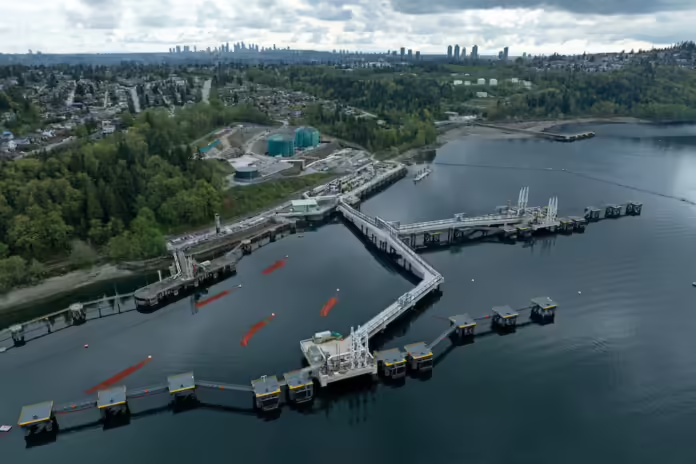
Canada’s Trans Mountain oil pipeline will rely heavily on last-minute shippers to turn a profit, the corporation’s financial projections show, clouding Ottawa’s efforts to sell the pipeline now that its C$34.2 billion ($25.04 billion) expansion is finished after years of delays.
Documents filed by Trans Mountain as part of a regulatory dispute over its tolls show it could take up to eight years to make money unless the pipeline fills thousands of barrels a day of uncommitted shipping space.
The 890,000 barrel-per-day (bpd) pipeline started service in May and reserves 20% of its space for uncommitted, or spot, customers, who pay higher tolls than shippers with long-term contracts.
Documents filed with Canadian regulators in April show different utilization scenarios for that 178,000 bpd of spot capacity.
In a scenario with zero spot shipments, the pipeline would not generate positive equity return – earnings after depreciation, interest and taxes are subtracted – until 2031. If, as Trans Mountain forecasts, the pipe runs 96% full from next year, equity return turns positive in 2026.
This month, a Trans Mountain executive told Reuters a “little bit” of spot capacity is being used. Mark Maki, Trans Mountain’s chief financial officer, said spot capacity was important to the company’s overall economics and he expected volumes to rise late in the year.
But spot-shipping demand is difficult to forecast because it relies on the fluctuating price of Canadian oil versus other heavy crudes in the U.S. and Asian markets, said Morningstar analyst Stephen Ellis.
He described Trans Mountain’s long-term forecast for 96% utilization as aggressive.
“One of their biggest Achilles’ heels is the reliance on spot,” said Robyn Allan, an independent economist who has studied Trans Mountain’s finances. “Everything is based on a very optimistic set of projections for the next 20 years.”
The rival Enbridge (ENB.TO), opens new tab Mainline, which takes crude to the U.S. Midwest and eastern Canada, offers 100% spot capacity but tolls are roughly half Trans Mountain’s rate. TC Energy’s (TRP.TO), opens new tab Keystone pipeline to the U.S. reserves around 10% spot capacity.
One Canadian crude trader said spot demand for Trans Mountain would depend on how full rival pipelines are.
Canada Development Investment Corporation (CDEV), the government corporation that owns Trans Mountain, noted in May 2023 that higher tolls may deter customers.
“Forecast tolls for pipeline transportation are higher due to (the expansion’s) cost escalation and have lessened competitive advantages,” CDEV said.
Costs surged during construction to nearly five times the 2017 budget and sparked a backlash from committed shippers including Suncor Energy (SU.TO), opens new tab and Canadian Natural Resources (CNQ.TO), opens new tab, who face higher-than-expected tolls as a result.
One mountainous segment soared from an estimated C$377 million in 2017 to C$4.6 billion in 2023 after hitting technical difficulties. Other segments passing through Metro Vancouver jumped from C$310 million to C$1.7 billion over the same period.
NO HURRY TO SELL
Prime Minister Justin Trudeau’s government bought Trans Mountain in 2018 to ensure the expansion, which has nearly tripled shipping capacity from Alberta to the Pacific coast, proceeded.
However Ottawa never intended to be the long-term owner and Canada’s Finance Ministry said it is planning a sales process.
Spokeswoman Katherine Cuplinskas said the expansion was an important economic investment, creating revenues and well-paying jobs.
Maki urged Ottawa not to hurry the sale given uncertainties over spot demand, the tolling dispute, and Ottawa’s plan to sell a stake to Indigenous communities.
“If you’re trying to sell something, and you have uncertainties, it’s going to affect the value someone’s going to pay for it,” Maki said.
Trans Mountain has borrowed C$17 billion from the Canadian government and has a C$19-billion syndicated loan facility from commercial banks. The April financial projections show it could pay more than C$1 billion in interest annually until 2032, although that will depend on interest rates and the corporation’s future capital structure.
Morningstar’s Ellis said even Trans Mountain’s best-case projections show the pipeline will only generate around 8% return on equity by 2034, which he described as the minimum acceptable level for a quality Canadian midstream asset.
Trans Mountain’s debt-to-EBITDA ratio, a measure of how well a company can cover its debts, starts at 11.6 in 2025 and remains above the typical level of 3.5 for a midstream firm until 2040, he said.
“If this was not a government-owned entity the market would have a really hard time supporting it. Those leverage ratios are like junk,” Ellis said.
Trans Mountain said interest payments will likely be reduced if the corporation is recapitalized, and it is working with the government on optimizing its financing plan.
Many analysts say Ottawa will need to take a discount on its investment to make Trans Mountain appealing.
Pembina Pipeline Corp (PPL.TO), opens new tab, the only listed company to publicly express interest in buying Trans Mountain, recently said there was still too much uncertainty. Indigenous groups are also awaiting more clarity.
“Until the tolls are resolved, it will indeed be challenging to move forward with the sale of the pipeline,” said Stephen Mason, CEO of Project Reconciliation, an Indigenous-led group that wants to bid for a stake in Trans Mountain.
Contracts to buy U.S. previously owned homes unexpectedly fell in May, indicating sales could remain subdued for a while as potential buyers grapple with higher mortgage rates and prices.
The National Association of Realtors (NAR) said on Thursday its Pending Home Sales Index, based on signed contracts, dropped 2.1% last month to 70.8. Pending home sales fell in the densely populated South and the Midwest, which is considered a more affordable region. The rose in the Northeast and West.
Economists polled by Reuters had forecast contracts, which become sales after a month or two, rebounding 2.5%. Pending home sales dropped 6.6% in May on a year-on-year basis.
“The market is at an interesting point with rising inventory and lower demand,” said NAR Chief Economist Lawrence Yun.
The housing market has been thumped by a resurgence in mortgage rates, with sales and home building slumping in May.
Residential investment is expected to have softened in the second quarter after posting double-digit growth in the January-March quarter.
The average rate on the popular 30-year fixed-rate mortgage reached a six-month high of 7.22% in early May before retreating to 7.03% by the end of the month, data from mortgage finance agency Freddie Mac showed. It has since dropped to an average of 6.87% during the week ending June 20.
“The first half of the year did not meet expectations regarding home sales but exceeded expectations related to home prices,” said Yun. “In the second half of 2024, look for moderately lower mortgage rates, higher home sales and stabilizing home prices.”
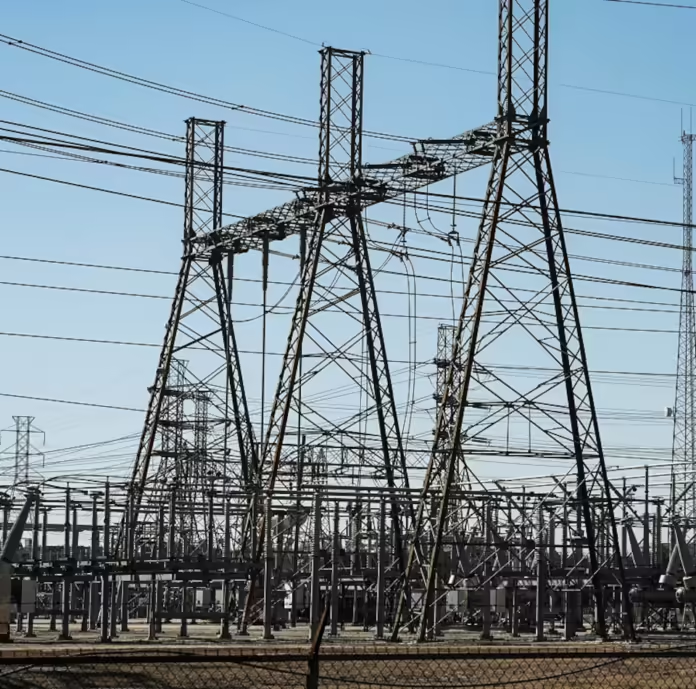
Progress in New Jersey shows how East Coast grid operators are moving forward with proactive transmission investments for new offshore wind projects.
In the next few months, the New Jersey Bureau of Public Utilities (NJBPU) will award a project to build an underground onshore transmission corridor to deliver power from offshore wind projects, following a competitive tender earlier this year.
The corridor, which is part of New Jersey’s plan to build 7.5 GW of offshore wind capacity by 2035, will connect a landing site for four offshore wind farms to a planned substation that will inject the clean power onto the backbone of regional PJM transmission network.
The PJM network was historically designed to carry power from generation facilities in Ohio, Pennsylvania and Illinois to population centers on the East Coast and new offshore wind farms will require more capacity from East to West.
The corridor should alleviate some of the onshore transmission risks for offshore wind developers and is part of a portfolio of projects set out by New Jersey under a new State Agreement Approach, opens new tab led by PJM.
Bidders in the tender include a partnership between National Grid Ventures and Con Ed Transmission and the corridor is expected to be operational by 2029.
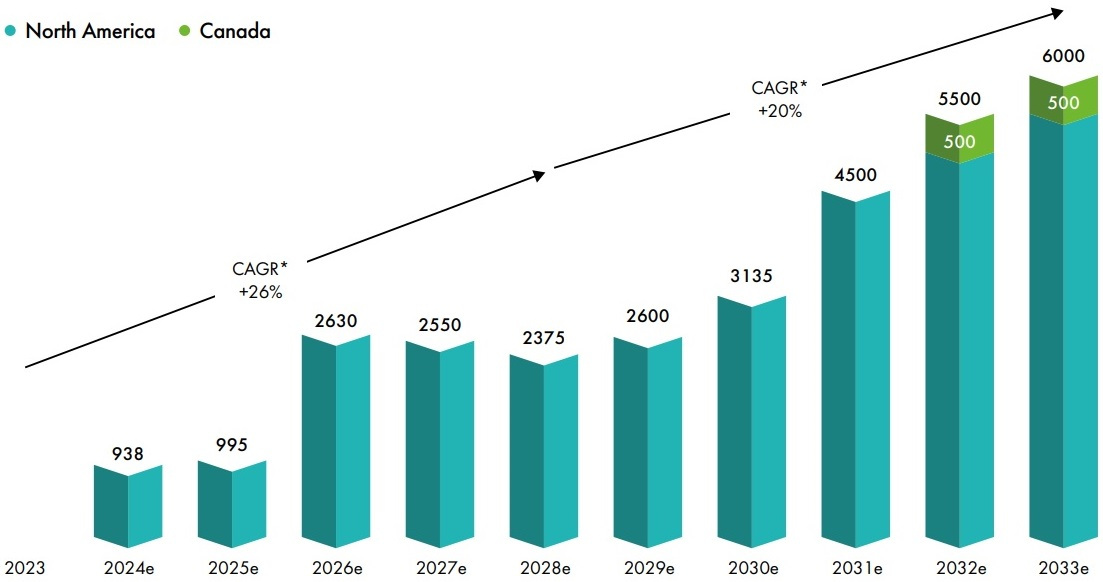
CHART: Forecast annual offshore wind installs in US, Canada
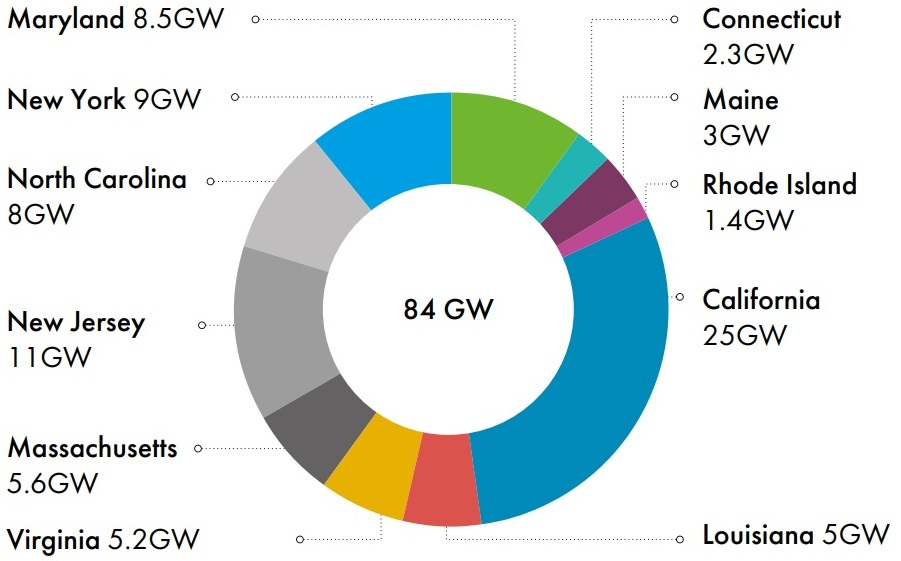
A lack of transmission capacity will become an increasing problem for offshore wind developers as the U.S. pushes towards its goal of 30 GW offshore wind capacity by 2030. Developers have already had to navigate soaring costs, supply disruptions and a lack of installation vessels, opens new tab, leading to several project cancellations.
“For offshore wind developers, connecting onshore to the grid has become a major risk factor and a major time sink. The New Jersey approach will not only lower total customer costs but also risks for offshore wind developers,” said Joe DeLosa III, a Manager at the Brattle Group, a consultancy that has advised the NJBPU on its transmission plans.
State support
Transmission projects can be derailed by local opposition and after studying several proposals, New Jersey decided a corridor that uses landing points on state-owned land was the most feasible option, using analysis conducted by Brattle.
“Selecting a specific landing point on state-controlled land streamlines permitting, enables robust advance vetting of the site, and reduces community impact,” DeLosa said.
NJBPU defined the endpoints for the corridor, leaving developers to bid their proposed route.
“By pre-building ducts to accommodate the cables for multiple wind farms, the number of individual construction efforts and associated community impacts are reduced significantly,” DeLosa noted.
For exclusive wind insights, sign up to our newsletter. , opens new tab
Planned offshore wind farms that will connect to the corridor include the 1.3 GW Attentive Energy Two (TotalEnergies and Corio Generation) and the 2.4 GW Leading Light Wind (Invenergy and energyRe) projects. Both were allocated power contracts, opens new tab by New Jersey in January and are due online after 2030. Attentive Energy supports New Jersey’s efforts to proactively plan for transmission infrastructure for the offshore wind sector, a spokesperson said. The company declined to comment on the transmission tender.
It is unclear what other projects might benefit but New Jersey in May launched its fourth offshore wind auction, opens new tab to secure between 1.2 GW and 4 GW of additional offshore wind power.
The substation connected to the corridor is being built by Mid-Atlantic Offshore Development, a 50:50 partnership between Shell and EDF Renewables. The two companies are building the 1.5 GW Atlantic Shores 1 offshore wind farm, which is scheduled to start producing power in 2027 and will use a different landing point further south.
Bidding for grids
National Grid Ventures and Con Ed Transmission presented a bid called the Garden State Energy Path, which would enable the delivery of around 6 GW of offshore wind energy over a 12-mile route.
The partners worked with offshore wind developers and sought to minimise community impacts, they said.
“We have deep relationships with offshore wind developers. We have spent a lot of time thinking how to do this from their perspective, in an efficient and efficient way,” Will Hazelip, President of National Grid Ventures, U.S. Northeast, said.
The NJBPU has not revealed how many bids were made in the tender and offshore wind developers will be keen for the transmission build to go smoothly.
The transmission builder will face a number of challenges, including complying with environmental regulations, securing rights-of-way, obtaining the necessary permits, and overcoming potential opposition from stakeholders, which could cause delays, warned Daniel Hagan, a Project Development and Finance attorney with White & Case.
For offshore wind developers, a misalignment between the completion of offshore wind farms and the new onshore transmission corridor “could create significant uncertainty,” White & Case said.
East Coast expansions
Progress is not confined to New Jersey. New York, opens new tab has also tendered for transmission that will inject a minimum of 4.8 GW of offshore wind capacity into the New York City grid.
The New York solicitation, which closed on June 3, called for end-to-end proposals that include offshore interconnection points and cables, landing points, onshore transmission paths, as well as additional upgrades to existing infrastructure. The winning project would be operational by the end of 2032.
Bidders in New York include New York Transco, a transmission developer that is partly owned by Con Edison and National Grid.
Further north, the states of Massachusetts, Connecticut, Maine, New Hampshire, Rhode Island and Vermont are seeking federal funding from the U.S. Department of Energy’s Grid Innovation Program (GIP) for a portfolio of transmission projects that would unlock up to 4.8 GW of new offshore wind capacity. Their “Power Up New England” plan also calls for the installation of battery storage systems to optimize delivery.
The states have also applied for federal funding to build a 345 kV transmission line to increase transfer capacity between New England and New York by up to 1 GW.
Offshore wind developers were further boosted by new rules issued by the Federal Energy Regulatory Commission (FERC) last month that aim to accelerate interregional transmission investments.
In the first major overhaul of transmission policy in a decade, the rules require grid operators to plan large-scale transmission infrastructure projects over a 20-year timeframe to anticipate future needs. These plans will need to be updated every five years.
The rules also reduce barriers to grid investments by allowing grid operators to share the costs with the states and generators that will benefit from the new infrastructure.