Home Blog Page 30

How Donald Trump got convicted at his hush money trial

0
 In their opening statement at Donald Trump’s criminal trial, the prosecutors seeking to win the first-ever criminal conviction of a sitting or former U.S. president made a bold prediction: they would have hard evidence to back up testimony from Michael Cohen, the star witness branded a liar by the defense.
Over the next several weeks, jurors heard testimony from insiders at Trump’s real estate company, his 2016 presidential campaign, and his White House that methodically backed up the two core elements of Manhattan District Alvin Bragg’s case: that Trump was aware of a “catch-and-kill” conspiracy to buy the silence of people with negative information before the election, and that he was involved in a cover-up of Cohen’s hush money payment to a porn star.
That testimony – coupled with evidence such as bank records, emails and a surreptitious recording of Trump speaking about a hush money payment – culminated in the 12-member jury finding Trump guilty of criminal charges.
Its verdict: He illegally falsified business records to hide his reimbursement to Cohen for the $130,000 Cohen paid to buy the silence of porn star Stormy Daniels before the 2016 election about an alleged sexual encounter she had with Trump in 2006.
To be sure, jury deliberations are secret and the reasoning behind the decision to convict will not be clear unless any jurors decide to speak publicly. Trump is almost certain to appeal his conviction.
Cohen testified at the trial in New York state criminal court in Manhattan that the reimbursement payments were falsely labeled as legal retainer fees in Trump’s family real estate company’s books. Cohen said Trump directed him to pay off Daniels, and that he would not have done so without getting paid back.
“He stated to me that he had spoken to some friends, some individuals, very smart people, and that: ‘It’s $130,000. You’re like a billionaire. Just pay it,’” Cohen said on May 13. “And he expressed to me: ‘Just do it.’”
The verdict vindicated Bragg, the Manhattan district attorney who was criticized by both Trump’s fellow Republicans and some of Bragg’s fellow Democrats for bringing a case involving well-known allegations of sexual impropriety, even if the transaction that mattered was financial.
Bragg argued the case was truly about an effort to corrupt the 2016 election – not sex.
“It was the subversion of democracy,” prosecutor Joshua Steinglass said in his May 28 closing statement. The “catch-and-kill” conspiracy, he said, was meant “to manipulate and defraud the voters, to pull the wool over their eyes in a coordinated fashion.”
The case is widely viewed as less consequential than the other three criminal cases Trump faces on charges over efforts to overturn his 2020 election loss to Democratic President Joe Biden and his retention of sensitive government documents after leaving the White House in 2021.
Trump has pleaded not guilty in the other three cases, which are unlikely to reach juries before his Nov. 5 election rematch with Biden.

‘OUT OF CHARACTER’

One challenge for Bragg’s case was Cohen’s credibility. Cohen went to prison after pleading guilty in 2018 to violating campaign finance law with the payment to Daniels and lying to Congress in 2017 about a Trump Organization real estate project in Russia. Trump’s lawyer Todd Blanche hounded Cohen on cross-examination about his lies to journalists and an instance in which he stole from Trump’s company.
So prosecutors needed plenty of evidence backing up Cohen’s testimony that Trump was aware of Cohen’s payment to Daniels, which they argued was part of a broader conspiracy to buy the silence of people with potentially negative information about Trump in violation of campaign finance laws.
Jurors did not have to rely solely on Cohen’s testimony to accept that Trump intended to conceal that alleged conspiracy by labeling his 2017 payments to Cohen as legal retainer fees.
David Pecker, the then-publisher of the National Enquirer tabloid, testified that he agreed at an August 2015 meeting with Trump and Cohen to be the campaign’s “eyes and ears” for women coming forward with unflattering stories about Trump.
Jurors heard a tape Cohen surreptitiously recorded of Trump on Sept. 6, 2016, discussing a hush money payment Pecker’s company made to Karen McDougal, a Playboy model who says she had a year-long affair with Trump in 2006 and 2007. Trump denied having ever had a sexual relationship with her or with Daniels.
Jurors saw phone records showing Cohen had several calls with Trump and his bodyguard Keith Schiller – whom Cohen said would hand his phone to Trump – around the time of frantic negotiations with Daniels’ lawyer over the payment in October 2016.
In some of his most damning testimony, Cohen said he, Trump and then-Trump Organization Chief Financial Officer Allen Weisselberg discussed the repayment plan in a January 2017 meeting shortly before Trump’s inauguration as president.
Weisselberg, who is serving a five-month jail sentence after pleading guilty to perjury in a separate case, did not testify for either side at the trial. But jurors saw Weisselberg’s handwritten notes – jotted down on a copy of the wire transfer receipt for Cohen’s payment to Daniels’ lawyer – with instructions as to how Trump Organization controller Jeff McConney should pay Cohen. McConney testified that he understood the payments to be a reimbursement for Cohen, not legal fees.
Hope Hicks, a former communications aide of Trump’s, recalled Trump telling her that Cohen paid Daniels “out of the kindness of his own heart” – consistent with the defense’s efforts to distance Trump himself from the hush money deals.
But Hicks expressed skepticism of that claim.
“That,” Hicks testified on May 3, “would be out of character for Michael.”
EU sticks to January 2025 start for final batch of Basel bank capital rules

0
 The European Union said on Thursday it had given final approval to roll out the remaining batch of tougher bank capital rules from January 2025, building on safeguards introduced after taxpayers had to bail out lenders in the global financial crisis over a decade ago.
The bulk of the Basel III rules, written by the Basel Committee of banking regulators from the world’s major economies, has already been implemented, but the final batch includes a major addition known as an ‘output floor’.
This safeguard aims to stop big banks, who can use their own computer models to calculate capital buffers, from gaming the system at the expense of smaller rivals, who must use more conservative calculation methods set out by regulators.
“The rules adopted today will ensure that European banks can continue to operate in the face of economic shocks,” Vincent Van Peteghem, minister for finance for Belgium, which holds the EU presidency, said in a statement.
“They will also make the banking sector more sustainable and better able to deal with the green and digital transitions. This is an important step towards deepening the Banking Union.”
The bloc has included other rules, not part of the Basel norms, to harmonise the minimum requirements across the 27-country bloc for authorising branches of banks that are headquartered outside the EU.
The package also includes transitional capital requirements for banks’ holdings of crypto assets, and changes to enhance how lenders manage environmental, social and governance (ESG) risks.
EU states said the rules would start to be rolled out from January 2025, though European Central Bank policymaker Francois Villeroy de Galhau on Wednesday said they should be delayed if the United States is late, to avoid a competitive disadvantage for European banks.
The Federal Reserve has proposed applying the final Basel rules from mid-2025, the same time as Britain, but huge U.S. industry pushback against the Fed’s “Basel Endgame” package has cast doubt on timings.

UBS splits wealth management role as part of executive reshuffle

0
UBS (UBSG.S), opens new tab said on Thursday it would split its top wealth management role as part of a shake-up, opens new tab of its executive board, creating new responsibilities for two leading contenders to eventually run the Swiss bank after CEO Sergio Ermotti.
Rob Karofsky, head of UBS’s investment bank, will in July become head of the Americas and co-president of global wealth management alongside current wealth management boss Iqbal Khan, who will now also take charge of the Asia-Pacific region.
Khan, a Swiss citizen, will relocate to Asia to assume the new role from Sept. 1. Khan and Karofsky, an American, are among the top internal candidates, opens new tab to succeed Ermotti, who the bank has indicated could stay in charge until at least 2027.
Vontobel analyst Andreas Venditti described the reshuffle as more far-reaching than expected.
“With these changes, Iqbal and Rob are the prime candidates for UBS’s CEO job,” he said.
Ermotti said in a statement the new appointments put “even more emphasis on our long-term priorities and growth prospects, particularly in the Americas and Asia-Pacific”.
According to a recent media report, Ermotti has rejected appointing an outsider as successor and intends to present internal candidates as he did when he last left UBS in 2020.
“Our goal is to really increase dramatically the chances that we can have an internal candidate,” Ermotti told Reuters this month.
Beatriz Martin, president of UBS Europe, Middle East and Africa, is also regarded as a potential successor to Ermotti.
UBS, which is in the midst of integrating its longtime rival Credit Suisse, made the announcements ahead of the merger of the banks’ main parent companies, scheduled to be legally completed on Friday. UBS acquired Credit Suisse last year.
Shares in the bank closed up just over 0.7%.
The parent merger is expected to allow the Swiss bank to get started with trickier stages of the integration such as combining IT systems, migrating clients from Credit Suisse and cutting the enlarged banks’ workforce of more than 110,000.
As part of the rejig, former Credit Suisse CEO Ulrich Koerner will retire from the bank later this year, UBS said.
The bank also named George Athanasopoulos and Marco Valla investment bank co-presidents, part of a series of changes UBS is putting into effect from July 1.
Damian Vogel will take over the risk officer role from Christian Bluhm as part of a previously announced exit. Bluhm will remain in an advisory capacity.
The president of UBS Americas, Naureen Hassan, is to step down effective July 1, one of a string of female executives who have left the bank in the last year.
Separately, the Swiss finance ministry said on Thursday it had fined UBS 50,000 Swiss francs ($55,340) for failing to alert authorities to suspected money laundering tied to Ali Abdullah Saleh, a former president of Yemen who died in 2017.
The case, initially reported by Swiss public broadcaster SRF, related to transactions Saleh conducted after he opened a UBS account in 2004.
UBS did not immediately reply to a request for comment.

Battle over power pylons highlights Britain’s net zero challenge

0
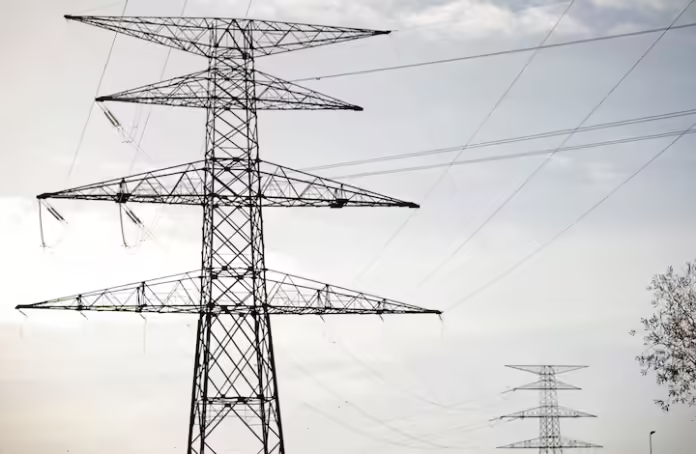
Dot Matthie says she faces losing the use of the airstrip in her field because of a British government plan to build electricity pylons in the area, which would put light aircraft in danger.
Will Gaze fears losing half of a field growing arable crops. Christine Murton says she sold her house at a big loss because of the scheme.
All three are part of an eclectic group of campaigners in the Waveney Valley and nearby areas in England’s East Anglia region fighting plans for high-voltage lines to carry wind and solar power across the rolling fields towards UK cities – part of the government’s strategy to reach net zero emissions by 2050.
The group is not opposed to green policies – most support the energy transition. But they object to 50 metre-high pylons being built in farmers’ fields, among the thatched cottages and winding lanes of villages, and in private gardens.
And they are threatening legal action if the proposals do not change.
Instead they want an offshore grid or cables underground, using new High Voltage Direct Current technology (HVDC).
That would cost more, underscoring the challenge Britain’s next government faces to build power infrastructure at a rate not seen in decades, at an affordable cost and without losing public support.
“It’s not green to actually bombard your way through precious woodlands and hedgerows,” said Murton. She said she sold her house in Waveney Valley as soon as she saw plans for two pylons to straddle her land with lines “straight across my back garden”.
She sold at a 300,000 pound ($375,000) loss, she said. Reuters was unable to confirm that independently.
Britain was a pioneer in offshore wind, with major farms built along its east coast. But as demand for electricity increases, the drive to build more pylons to carry power to London and elsewhere is being met with local opposition, legal challenges and planning delays.
Last year, the National Infrastructure Commission said the rate of large-scale projects being subjected to judicial review had hit 58% in recent years, from a long-term average of 10%.

GREEN ENERGY PROMISE

National Grid plans to build a new 180 km, 400,000-volt electricity transmission line between Norwich in Norfolk and Tilbury in neighbouring Essex to provide clean energy for six million buildings. It’s part of a plan to connect 50 GW of offshore wind by 2030.
The grid is consulting on options in the Waveney Valley after receiving complaints. But it says that underground cables would cost more and that would need to be paid for by residents. The local campaigners say that they would pay higher bills to protect their communities.
The campaigners are gearing up for a “planning battle”, assembling experts to argue that the project consultation was flawed and the Grid failed to consider alternatives.
“We’ve got heritage consultants, landscape consultants, soil consultants, environmental consultants,” said Rosie Pearson, founder of the campaign group “Pylons East Anglia”. “So they’re all looking at the methodology, and the findings of National Grid and where there are gaps.”
The grid says it has reviewed all options for the line and must opt for the most cost effective. It says an offshore grid using HVDC cables with the same capacity would cost almost 4.1 billion pounds, while pylons would cost around 895 million pounds ($1.1 billion) – a figure disputed by campaigners as too low.
With the legal challenges being replicated nationwide, the progress towards net zero has become intensely political, and is featuring in the campaign for a general election on July 4.
Richard Rout, the Conservative party’s parliamentary candidate for Waveney Valley and the former deputy leader of Suffolk County Council, wants the power lines underground or offshore. But the Conservative national government favours pylons, in general.
Rachel Reeves, finance policy chief of the opposition Labour Party, which looks set to win the July 4 election according to polls, backed the Grid’s proposals when she visited Norfolk in March, according to the local Eastern Daily Press.
“We’ve got to crack on and build the energy infrastructure to heat our homes and get people’s bills down,” she said.
Geoff Lazell, one of the campaigners, rejected the moniker of NIMBYs – those arguing “not in my back yard” at the prospect of new building. He said they were NOBYs – “in no one’s back yard”.
“The price to pay is not acceptable,” he said.

EU agrees to quit energy investment treaty over climate concerns

0
European Union countries unanimously agreed on Thursday to quit an international energy treaty over concerns that it protects fossil fuel investments and undermines efforts to fight climate change, the Belgian EU presidency said.
The 1998 Energy Charter Treaty (ECT) allows energy companies to sue governments over policies that damage their investments. In recent years, some companies have used it to launch billion-dollar lawsuits against measures to shut or restrict fossil fuel projects.
“I’m very happy and I will thank all of you around the table to work hard with the Belgian presidency team to break the stalemate on this file,” Belgian Energy Minister Tinne Van der Straeten said.
Brussels proposed an EU exit from the treaty last year, after member states including Denmark, France, Germany, Luxembourg, Poland, Spain and the Netherlands announced individual plans to quit, with most citing climate change concerns.
The bloc argued that the treaty was no longer in line with the Paris agreement on climate change and EU ambitions regarding the energy transition.
The European Parliament approved the EU exit last month.
“This is a historic moment and a significant victory for climate justice campaigners across Europe,” Climate Action Network (CAN) Europe said in a statement, adding the pressure would now be on those remaining EU countries that have yet to exit the ECT.
Member states which wish to remain contracting parties after the EU’s withdrawal will be able to vote during the upcoming Energy Charter Conference – expected to take place by end-2024 – by approving or not opposing the adoption of a modernised agreement, the Council of the EU said in a statement.
Before leaving, the EU agreed it will first approve reforms to the treaty – which aimed to make it more climate-friendly, but which some European governments said fell short.
The Energy Charter Treaty secretariat has not yet confirmed when treaty members will meet to vote on the reforms. It did not immediately respond to a request for comment.
Around 50 signatories to the treaty agreed the reforms in 2022. One of the key changes is the reduction to 10 years from 20 of a “sunset clause” that would apply to countries that quit.
During this period, energy firms from other signatory nations such as Japan and Turkey would continue to receive the treaty’s protection of their existing investments in the EU.

IBA president Kremlev defends divisive prize money scheme despite IOC pushback

0
The International Boxing Association’s (IBA) plans to offer prize money to medallists at the Paris Games could widen the rift in the governance of amateur boxing after the announcement drew sharp criticism from the International Olympic Committee (IOC).
The IBA’s move follows World Athletics’ announcement last month that they would offer $50,000 in prize money to Olympic champions, starting in Paris this year.
The governing body’s announcement was met with criticism from the IOC, whose President Thomas Bach suggested that the federation should instead use its funding to support athletes across the board.
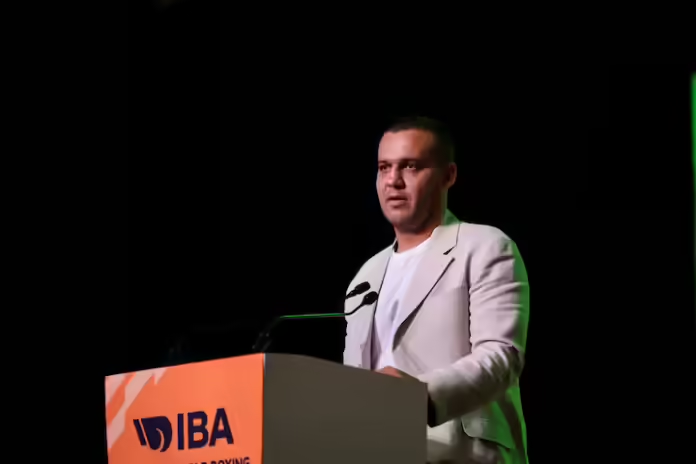
Despite the IOC’s disapproval, IBA President Umar Kremlev said World Athletics had made the right decision.
“For me, the spirit of the Olympic Games is to create the right conditions for athletes,” Kremlev told Reuters with the help of a translator.
“Athletes are the ones who attract sponsors and, of course, all the money should belong to the athletes. That’s the true spirit of the Olympic Games and the Olympic Movement. We know that is not what the IOC leadership does nowadays.
“IOC officials fly first class, live in five-star hotels, while the athletes don’t live in the best conditions… I see it like gladiatorial fights, where athletes are treated as if they are slaves.”
The two bodies have been at loggerheads for years, with the IOC stripping the IBA of recognition last June, saying it had failed to complete reforms on governance, finance and ethical issues.
Just as in Tokyo, the boxing tournaments in Paris are being organised by the IOC. But there are fears that boxing might be excluded from future Games, with the sport not on the initial programme for the 2028 Los Angeles Games.

PRIZE MONEY

The IBA said on Wednesday that it would pay prize money worth more than $3.1 million to boxers who win a medal or reach the quarter-finals at Olympic events.
However, the IBA did not disclose the source of their funding. It said the prize money would be handed out in a ceremony at the next IBA Congress, which will be held in November or December.
The IOC said they had taken note of the IBA’s announcement but questioned the source of the funds.
“This total lack of financial transparency was exactly one of the reasons why the IOC withdrew its recognition of the IBA,” it said.
Relations between the two bodies soured following Russia’s invasion of Ukraine in 2022, with the IBA run by Russian Kremlev and with Russian energy firm Gazprom being its main sponsor, though Kremlev said last year that the sponsorship had ended.
The IOC had also said it would not organise the boxing tournament in 2028, urging national federations to decide on a “credible, well-governed” successor to the IBA by next year.
The IOC warned national federations aligned with the IBA that they will not be able to participate in Los Angeles if boxing is on the programme.
“The respective National Olympic Committee will have to exclude such a National Boxing Federation from its membership,” the IOC added.

LEADING CANDIDATE

The leading candidate to replace the IBA is World Boxing, which launched in April last year and currently has 28 national federations, such as Great Britain Boxing and USA Boxing, as members.
Last month, World Boxing Secretary General Simon Toulson said the body was hoping to begin formal talks with the IOC over recognition as the sport’s official governing body.
But Kremlev said the IBA and IOC could still mend their broken relationship, predicting a changing of the guard after the Paris Games.
“The IBA does not have issues with the Olympic family. We have issues with certain personalities, namely Thomas Bach and his team,” Kremlev said.
“I believe that their work is not transparent and democratic. Their actions do not meet the responsibilities that they have.
“We believe that after the Olympic Games, we will see some renewal in the IOC leadership and this will allow the IBA to restore its relationship with the IOC.”

Is the U.S. technology sector ripe for a spin cycle?

0
Big tech companies currently have several good reasons to spin off portions of their businesses into standalone public entities. Unlocking hidden shareholder value, reducing operational inefficiencies, and securing a readily available market of investors comprised of their own existing shareholders — all are good arguments for tech firms to consider spin-off transactions.
But with rapidly advancing AI technology combined with hard scrutiny from government regulators, one of the best reasons for tech giants to consider spin-offs is to remain competitive and nimble in ways that larger organizations simply cannot.
Separating a company into multiple standalone publicly listed entities is among the most complex of transactions to execute. Despite that, when conditions are right, spin-offs can help companies add tremendous value and remain competitive internationally.
This article explores the use of spin-offs in recent decades, why time may now be ripe for a wave of these transactions, and how through spins tech companies can prepare for new opportunities for success.

What is a spin-off?

A spin-off is a separation transaction that results in the creation of one or more separate, publicly traded companies. Spins are popular when stakeholders believe that significant value will be unlocked through a standalone entity as compared to a single combined entity.
In a spin, instead of selling a business division to a third party, a public company “sells” a business line or lines to its own stockholders through a public listing of the carved out business and corresponding distribution of shares to the parent’s shareholders.
History shows an ebb and flow of acquisitions followed by spin-offs.
In the 1960s, due to a low interest rate environment, the United States experienced a sharp increase in leveraged buyouts across many sectors and a rise in corporate conglomerates as companies sought diversified operations to protect against economic downturns. But as interest rates rose, there was a decline in profits and a slowing of leveraged buyout activity. Equity markets began pricing in the operational inefficiencies of highly diversified companies. The resulting shift to focus on core competencies led to the first true wave of spin-offs in the 1980s.
Subsequent spin waves occurred in the early 2000s with large acquirers during the dot com boom reversing course as economic tides shifted and in the 2010s with tech companies citing the need to meet technology changes such as cloud computing and the internet of things. Spin-offs separated slower moving corporate giants from divisions that needed to more nimbly meet changes under less bloated cost structures.

Why a wave of spin-offs for Big Tech?

The top players in the US public tech sector are now some of the most valuable companies in the history of the world. According to the Boston Consulting Group, as of December 2021, the four largest technology companies accounted for almost half of all technology industry market value since 2016, and more than 40% of the total market value of technology companies. “Tech Comes Out on Top. Can It Stay There?, opens new tab” BCG, March 10, 2022.
In 2023, these four companies accounted for approximately 16% of the Fortune 500’s total profits (“4 tech giants accounted for more than 16% of Fortune 500 profits — even in a down year, opens new tab,” Fortune, June 6, 2023) and 84% of the Nasdaq 100’s $4 trillion market valuation growth. “The ‘Magnificent 7’ tech stocks drive markets higher as AI mania grips investors,, opens new tab” yahoo!finance, May 30, 2023.
As of 2024, the combined market cap of the seven largest US tech companies would make them the second-largest country stock exchange in the world. “Magnificent 7 profits now exceed almost every country in the world. Should we be worried?, opens new tab” CNBC, Feb. 19, 2024.
However, with increasing regulatory headwinds and booming market valuations for artificial intelligence businesses, spins may offer a way to unlock hidden shareholder value and divest operational inefficiencies.

a. Regulatory headwinds:

It has been said that data is the new black gold. Many companies in the U.S. technology space have utilized the growth by acquisition model to pivot into new industries, capitalize on new technologies and diversify their company portfolio offerings — often on the back of using or extracting this precious commodity which fuels the artificial intelligence revolution. Understandably, we have begun to see a large increase in tech companies investing to grow their data and AI-backed divisions.
However, a rise in antitrust dialogue within the technology landscape has led to major blockbuster acquisitions being challenged in court by U.S, and foreign antitrust regulators and, in some instances, forced divestitures of business divisions. Inorganic growth, a key driver over the last decade or so, is no longer a viable option for many large players in the industry due to their dominance across multiple industry sectors.
Spin-offs can offer a “fix it first” type remedy to such regulatory scrutiny by breaking up businesses.
The United States’ first major merger wave, which began in the late 1800s, resulted in the creation of industrial titans such as Standard Oil and U.S. Steel. These companies were broken apart in the early 1900s by antitrust laws. It seems like monthly one hears of a new regulatory challenge to the tech behemoths. The question is now how the tech giants of today will respond to being in the global regulatory cross hairs?

b. Unlocking value:

It is no secret that Wall Street prefers simplicity and human beings generally prefer the same.
From this premise follows the idea that when you have a conglomerate with tens or hundreds of small divisions or business lines, the market oftentimes undervalues the smaller segments. A “conglomerate discount” is the term used to describe the tendency of markets to value a company with a diversified group of businesses at less than the sum of its parts. This discount typically increases in proportion to the size of the conglomerate.
Value may become hidden or lost within a large conglomerate and a spin-off provides a viable option for increasing visibility and unlocking additional shareholder return. Increased equity research visibility as a result of a spin can unlock hidden value derived from a range of factors, including: (i) differential valuation multipliers for business lines, (ii) disparate growth rate models across the segments (e.g., blue chip v. high-growth) and (iii) distinct pools of investor bases (e.g., tech v. hardware or AI v. SaaS).
If stock prices are trading low, as we have seen with recent market declines, activists are better able to target larger companies — meaning an increased risk of spin campaigns for larger technology companies (particularly those with business divisions that are darlings of the market such as artificial intelligence).
If a company is able to unlock hidden value of a high revenue growth division, such as an AI or data security business, it can allow for short-term recapture of value during market declines and increased shareholder returns once the market enters into an expansion period.

c. Focus on core business:

A spin-off is compelling from an operational perspective as it allows for greater management team flexibility and increased, segmented focus on overall business efficiency.
•Oftentimes, organizational lines are not optimized across divisions. When businesses are separated, it allows leaders to individually tailor their organizational structures as is most efficient.
•Incentives amongst employees could also be revamped and refocused consistent with business goals to more directly motivate employees and achieve objectives.
•Spins can also ensure that business lines do not need to compromise through shared resources — albeit at the loss of benefits of scale.
•In some cases, the spinco entity may actually have become ancillary to the parent’s business and a separation allows for increased managerial focus, unlocking hidden value and optimizing for efficiency. This is a model consistently seen to drive returns in the private equity world.

Conclusion

It is critical that the U.S. tech sector — the lynchpin of the U.S. competition internationally — surmount today’s market challenges. As we enter the era of artificial intelligence, the United States needs its tech giants to maintain their competitive edge — even as they face regulatory challenges. A spin cycle could provide these tech companies with a fresh start to develop, expand and capitalize on new market opportunities and remain competitive within the AI field.
It is recognized that separating a company into multiple stand-alone publicly listed entities requires disentangling business lines and setting up a new operating company, all combined with a capital market transaction (and, in certain instances, a third party M&A transaction as well). Years of planning can take place prior to the execution of a spin, which typically takes anywhere from six to 12 months from announcement to close.
But when the market for private sales to third party buyers is weak, interest rates needed for M&A debt financing are high and equity is volatile, a spin-off, with its readily available market for the spun off company’s stock (i.e., existing stockholders), provides execution certainty for a transaction that can unlock value and increase shareholders returns.

Saudi Arabia sets up new Aramco share sale that could raise $13.1 billion

0
Saudi Arabia’s government on Thursday filed papers to sell a new stake in state oil giant Aramco (2222.SE), opens new tab that could raise as much as $13.1 billion, a landmark deal to help fund Crown Prince Mohammed bin Salman’s plan to diversify the economy.
In the main part of the deal, Saudi Arabia could raise $12 billion by offering about 1.545 billion Aramco shares, equivalent to about 0.64% of the company, if it prices the sale at the top end of a 26.7 ($7.12) to 29 riyals range, according to Aramco’s filing on Riyadh’s Saudi Exchange.
The deal’s value could rise to $13.1 billion at the top end under a so-called greenshoe option which would allow the sale of nearly 1.7 billion shares, or a 0.7% stake. That option allows bankers to use shares to stabilize the price of the offering.
Investors have long anticipated the share sale as the energy giant has sought to widen its base while generating funds to turbocharge Saudi Arabia’s economic diversification programme.
“The offering provides us with an opportunity to broaden the shareholder base amongst both Saudi and international investors,” Aramco Chief Executive Amin Nasser told reporters on a call after the announcement.
“It also offers us an opportunity to increase liquidity and to increase our global index weighting.”
The offering is the culmination of a years-long effort to sell another chunk of one of the world’s most valuable companies following its record-setting IPO in 2019 raised $29.4 billion. About 10% of the latest offering will be reserved for retail investors, subject to demand.
Sources told Reuters last week the offering could happen as soon as June.
Since the IPO, Aramco has remained a cash cow for the Saudi government, financing a mammoth economic drive to end the kingdom’s “oil addiction”, as the crown prince once called it.
The latest deal will allow the kingdom to finance large domestic projects tied to that agenda, said Hasan Alhasan, senior fellow at the International Institute for Strategic Studies.
Having missed its target for foreign direct investment and with a budget deficit of up to $21 billion in sight, “the kingdom is resorting to the sale of equity in Aramco and to debt issuances,” he said.
“The kingdom is likely to continue redirecting capital to other sectors including renewable energy, technology, tourism, logistics and manufacturing, which Riyadh hopes will constitute sources of long-term economic growth,” he added.
Aramco shares closed 0.17% lower on Thursday at 29.1 riyals ($7.76), giving the company a market capitalization of about $1.87 trillion. Its IPO price valued it at $1.7 trillion, but shares traded 10% higher on their debut, roughly in line with its current valuation.
The company lifted dividends to almost $98 billion in 2023 from the $75 billion it had been paying annually, despite profit having dropped by nearly a quarter. It expects an outlay of $124.3 billion this year.
Aramco has also invested in refineries and petrochemical projects in China and elsewhere, expanded its retail and trading businesses, and sharpened its focus on gas, making its first foray into liquefied natural gas abroad last year.
Morgan Stanley, Citi, Goldman Sachs, HSBC, Saudi National Bank, Bank of America and JPMorgan are acting as joint global coordinators on the deal, with local banks Al Rajhi Capital, Riyad Capital, Saudi Fransi Capital acting as joint bookrunners.
There were roughly half the number of banks on the deal in comparison to Aramco’s IPO in 2019.

DIVERSIFICATION DRIVE

Saudi Arabia’s de-facto ruler MbS, as the crown prince is known, has poured hundreds of billions of dollars through the kingdom’s sovereign wealth fund into mega projects, and everything from electric vehicles to sports and a new airline, to diversify the economy away from hydrocarbons and create jobs.
But lower oil prices and production weighed on economic growth last year while spending rose, leading to a fiscal deficit of around 2% of GDP, with a similar deficit expected this year.
Aramco introduced a special performance-based dividend last year, providing cash to the kingdom and helping to lure new investors.
The company has also signed up more banks as market-makers to help improve liquidity in the shares.
The world’s biggest oil exporter trades at a higher price-to-earnings ratio than other global oil companies, including ExxonMobil, BP and Shell.
The stock is down about 12% this year, while shares of ExxonMobil and BP are up around 14% and 4% respectively.
Saudi Arabia is the de facto leader of the Organization of the Petroleum Exporting Countries, helping engineer price moves on world oil markets.
Aramco currently produces about 9 million barrels of crude a day, about three quarters of its maximum capacity, to comply with output cuts agreed by OPEC and its allies, known as OPEC+.
OPEC+ is set to decide its next production policies on Sunday, and several sources and analysts expect the meeting to roll over existing cuts into the second half of 2024.
Should OPEC+ surprise the market and cut production further, oil prices could rise from the current roughly $82 a barrel, but Aramco would have to reduce output and face even lower revenues.

Canada’s RBC, CIBC post bigger-than-expected profits on capital markets strength

0
Royal Bank of Canada (RBC) (RY.TO), opens new tab said on Thursday the investment banking environment looked promising after the country’s biggest bank surpassed profit expectations, driven by its capital market business.
Canadian Imperial Bank of Commerce (CM.TO), opens new tab, the country’s fifth-largest bank by asset value, also beat profit expectations on capital markets strength and as it set aside smaller than expected funds for potential loan losses.
The resurgence in merger and acquisition activity after a long lull as interest rates soared, has helped Canadian banks’ capital markets businesses in recent quarters, even as loan loss provisions limit profits.
The results round out a mixed earnings season for Canada’s big six lenders, which have been looking to diversify in the U.S. as domestic competition intensifies.
RBC and CIBC shares rose about 4% and 5% respectively, lifting the broader TSX finance index. (.SPTTFS), opens new tab
“We continue to think the environment will remain quite constructive if we look at the fundamentals for investment banking,” said Derek Neldner, head of RBC Capital Markets.
He said, however, that banks face a seasonal slowdown in merger activity in the second half of the year and uncertainty about high interest rates and global elections, including in the United States.
“If we’re in a higher-for-longer scenario and financing costs remain a little elevated, combined with… uncertainty as we look at a range of global elections underway, we think that will likely moderate activity,” he said.
RBC’s capital markets segment recorded a 31% rise in net income in the quarter.
The top six Canadian banks, which together control more than 90% of the country’s banking market, have struggled amid high interest rates that strained consumers’ wallets as monthly mortgage payments, credit card bills and living costs rose.
Provisions for credit losses at RBC came in at C$920 million ($673.45 million), higher than analysts’ forecast of C$880 million, according to LSEG data.
CIBC recorded lower loan loss provisions in its commercial banking segment in Canada and the U.S., a market where it was previously hit due to its exposure to office real estate.
RBC’s quarter highlighted “manageable credit costs, and a solid capital position” following the acquisition of HSBC’s domestic unit this year, KBW analyst Mike Rizvanovic said.
“A solid quarter overall,” he said on CIBC’s performance.
RBC’s profit climbed 7% to C$3.95 billion. On a per-share basis, it earned C$2.92, beating the average estimate of C$2.75.
CIBC earned C$1.75 per share, topping the estimate of C$1.65 per share.