Lloyds Banking Group (LLOY.L), opens new tab is set to make an extra 300 million pounds ($380 million) a year in revenue by 2026 from its business banking unit, CEO Charlie Nunn said on Thursday, as corporate confidence picks up in Britain despite challenges.
The British bank’s Business and Commercial Banking (BCB) unit, which serves firms with up to 100 million pounds in turnover, will have reached two thirds of the target by the end of this year, Nunn told analysts in a presentation.
That has come from cross-selling more products to customers and digitising services, BCB head Elyn Corfield said.
The business banking push forms part of a wider, previously announced ambition to deliver an additional 1.5 billion pounds in revenues per year from strategic initiatives, as Lloyds tries to insulate itself against the impact of falling interest rates.
Nunn said small and mid-sized companies had a significant role to play in spurring British economic growth, particularly as rates started to fall and investment picked up.
“The cost of borrowing will make a difference,” he said, noting rising confidence, especially in high-growth sectors.
Nunn earlier told Sky News that mortgage rates were falling and would likely settle in a range of 3.5%-4.5%, having been in the 1.5%-2.5% range for most of the last decade before central bank rate hikes sent home loan costs soaring above 5%.
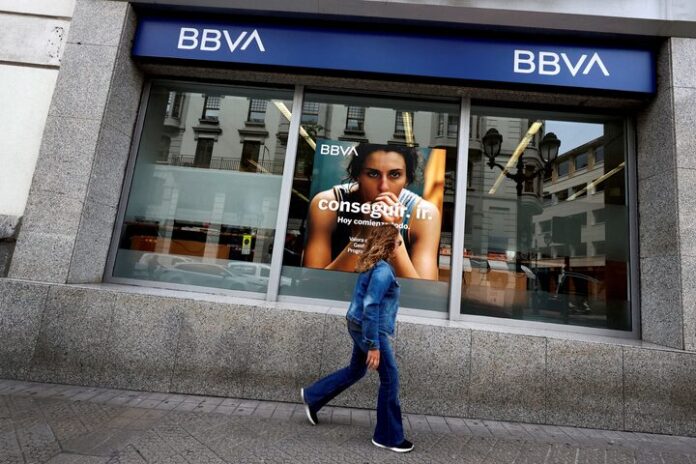
Spanish bank BBVA’s (BBVA.MC), opens new tab shareholders will vote on July 5 on whether to approve a share issue to fund its 12 billion euro ($13 billion) hostile takeover bid for smaller rival Banco Sabadell (SABE.MC), opens new tab.
The bank wants to issue 1.126 billion new shares, which at BBVA’s closing price of 10.9 euros on April 29 – before the bank revealed its Sabadell bid – would be worth slightly more than 12.2 billion euros.
BBVA has offered one newly issued BBVA share for every 4.83 in Sabadell, representing a premium of 30% over Sabadell’s April 29 closing price of 1.73750 euros.
“With this capital increase we take a step in the purchase process with Banco Sabadell’s shareholders,” BBVA’s Chairman Carlos Torres said in a statement.
As shares of BBVA have fallen to 9.97 euros from 10.90 euros since the bid’s announcement, the premium is now just above 6%, valuing Sabadell at around 11.2 billion euros, according to Reuters calculations.
The final amount of the capital increase will depend on the number of Banco Sabadell shareholders who take up the offer.
BBVA, whose approach turned hostile after its smaller rival rejected its initial offer, had set itself a minimum approval threshold of 50.01% of Sabadell shareholders.
New York Community Bancorp’s (NYCB.N), opens new tab one-for-three reverse stock split will become effective mid-to-late July, the regional lender said on Thursday.
The bank’s shares are down nearly 71% since the end of January, following a surprise quarterly loss due to commercial real estate stresses and a dividend cut.
An investment from a group that included former U.S. Treasury Secretary Steven Mnuchin’s Liberty Strategic Capital stabilized the stock, but trading remains rangebound.
NYCB shares dipped nearly 2% before the bell on Thursday.
Reverse stock splits typically boost prices by reducing the number of outstanding shares. NYCB first unveiled the plan in March and shareholders ratified it earlier this month.
In a regulatory filing earlier in June, NYCB said the split could make the stock price “more attractive to a broader group of institutional and retail investors.”
Banks in the European Union could be inflating the value of high-risk debt used to plug gaps in capital buffers intended to provide protection in the event of a crisis, the bloc’s banking watchdog said on Thursday.
Banks began issuing Additional Tier 1 (AT1) bonds, also known as contingent convertibles or CoCos, to bolster their capital after the global financial crisis.
They convert into equity or are written off if a bank’s capital drops below a certain level.
There have been clashes between buyers of the debt and banks, most recently when Credit Suisse AT1 debt amounting to about $17 billion was written down to zero when the ailing lender was forced to merge with UBS, triggering lawsuits.
The European Banking Authority (EBA) said it has investigated how banks issue AT1 bonds and set out its findings in a report on Thursday, opens new tab that included new templates to better standardise information and more accurately reflect their worth.
The aim of the guidance is to limit the room banks have to introduce bespoke tweaks when issuing AT1 bonds.
“Some provisions could be worded in a better way because, as originally proposed, they may be the cause of uncertainty in relation to regulatory provisions … or they may increase the already high complexity of the instruments,” the EBA said.
It noted differences between the “carrying” value of the bonds recorded on a bank’s balance sheet under accounting rules and their “nominal” value.
“For the calculation and reporting of regulatory capital ratios, it is essential that capital instruments consistently reflect their actual loss absorbency capacity,” it said.
The findings show the importance regulators are placing on examining the level of capital banks have at their disposal when they are in trouble, said Chris Woolard at accountancy firm EY.
“The industry can almost certainly expect further probes in the short-term, and investors and regulators will be looking for greater standardisation across the banking sector,” he said.
Simon Ainsworth, associate managing director, Financial Institutions Group at Moody’s, said a standardised and conservative way of valuing AT1s “would improve transparency, reduce legal risk and increase investor certainty”.
The European Central Bank declined to comment.
Regulators globally are looking at whether the events at Credit Suisse mean that changes are needed to the use of AT1 bonds in capital buffers.
The global Basel Committee of banking regulators has said that after banking sector turmoil, opens new tab last year, which included Credit Suisse, there could be merit in assessing the complexity, transparency and understanding of AT1 bonds.
Rivian (RIVN.O), opens new tab will be able to slash a fifth of its material costs from electric SUVs and pickups by the end of 2024, CEO RJ Scaringe said on Thursday, after a recent factory overhaul and a vehicle redesign to aid its push to profitability.
Shares of Rivian, which fell as much as 8.9%, were last down less than 3% after the company reaffirmed its largely flat annual production growth forecast.
The stock had risen 23% after its best-ever one-day gain of 23% on Wednesday after Volkswagen (VOWG_p.DE), opens new tab said it would invest up to $5 billion in Rivian as part of a joint venture for its EV architecture and software.
The move is widely seen as a “vote of confidence”, opens new tab in the American automaker’s prospects as it looks to build less expensive R2 and R3 crossovers. The tie-up with Volkswagen is expected to help reduce operating expenses at Rivian as production volumes rise.
COST SAVINGS
Scaringe also said material cost for its less expensive and smaller R2 vehicles will be 45% lower than its flagship R1 vehicles.
“Incredible focus and discipline around electronics in the vehicle will represent one of the biggest cost savings in R2 relative to R1,” Scaringe said at the company’s first investor day since going public in November 2021.
Rivian shut down its plant at Normal, Illinois for three weeks in April to make the changes, including simplifying processes and removing equipment at the facility, as well as eliminating over 500 parts from the vehicles in an effort to make them cheaper to build.
A similar exercise last year helped Rivian cut 35% in material costs from its electric vans, Scaringe told Reuters last week.
Amazon.com-backed (AMZN.O), opens new tab Rivian lost about $39,000 per vehicle sold in the first quarter, but the company is confident it will post its first quarterly gross profit in the fourth quarter.
To save cash, Rivian plans to start making the R2 vehicles at its existing Illinois facility, instead of a planned plant in Georgia. The company is also renegotiating supplier contracts and building some parts in house to better control costs.
The company’s presentation during investor day also teased five new models, with three vehicles under the “affordable mass market” category.
LONG-TERM FINANCIAL TARGETS
Demand for electric vehicles has faltered amid high borrowing costs, and as buyers turn to cheaper gasoline-electric hybrid vehicles.
The slowdown has hit even market leader Tesla (TSLA.O), opens new tab, which is expected to report its first drop in annual sales this year.
EV makers including Tesla have been cutting prices, offering incentives and introducing lower-priced variants to boost sales.
In the long term, Rivian targets a gross profit margin of 25% and adjusted core profit margin in the high-teens, finance chief Claire McDonough said.
Rivian had nearly $6 billion of cash and cash equivalents at the end of the March quarter.
The company expects to produce between 9,100 and 9,300 units in the second quarter and hand over between 13,000 and 13,300 vehicles to customers in the April-June period.
Wall Street is expecting quarterly deliveries of 10,282 units and production of 9,369 vehicles, when the company reports quarterly figures on July 2, according to analysts polled by Visible Alpha.
The company has stuck to its production forecast of 57,000 for the year – roughly the same as 2023.
Switzerland and the United States signed an agreement on Thursday for a mutual exchange of financial account data, the Swiss Federal Department of Finance said.
Switzerland currently provides financial account data to the United States on a unilateral basis, but in future, it will also receive corresponding information from the United States within the framework of an automatic exchange of information, Bern said.
The change is expected to apply from 2027.
The Foreign Account Tax Compliance Act (FATCA) is a set of US regulations that has applied worldwide for all countries since 1 January 2014.
SM Energy (SM.N), opens new tab said on Thursday it had agreed to buy some shale assets of oil and gas producer XCL Resources for about $2 billion, extending its footprint in the Uinta region in Utah, sending its shares down 10%.
XCL, backed by EnCap Investments and Rice Investment Group, is one of the largest producers in the region with an output of around 55,000 barrels of oil equivalent per day.
Denver-based SM Energy, which operates in the Eagle Ford and Midland Basins in Texas, plans to finance the acquisition through a combination of debt and cash on hand.
“We don’t think investors will be enthused about entering the Uinta Basin. SM (Energy) is adding a fair bit of leverage on this transaction, but we see solid free cash flow paying a lot of this off in the next 12 months,” said analysts at Roth MKM in a note.
A deal in the Uinta basin was a chance to maintain capital discipline, SM Energy executives said in a conference call, while getting a good multiple and higher oil mix. Once the deal is completed, likely in September, the output from legacy assets will fall, they added.
The company expects oil to be greater than 50% of total production following the deal from 43% in 2023.
Northern Oil and Gas (NOG.N), opens new tab will also buy 20% of the oil and gas assets of XCL for $510 million, resulting in a total deal value of $2.55 billion.
Reuters reported in March that XCL Resources could be worth at least $2.8 billion, including debt.
A consolidation in the U.S. energy sector that triggered $250 billion worth of deals in 2023 has stretched into this year, as companies look for opportunities to deploy their cash hoard and boost their reserves – this deal
SM Energy will serve as the operator of the assets and the deal will extend the company’s reserves by two years. .
Mexican President-elect Claudia Sheinbaum named close ally and former Mexico City finance chief Luz Elena Gonzalez as incoming energy minister, tasking her with revitalizing a struggling state oil company and increasing the use of renewables.
Sheinbaum, a former mayor of the Mexican capital, won a landslide election this month, giving the leftist Morena party its second straight presidential triumph.
Analysts were broadly positive about the pick though some did express concerns about her lack of energy experience.
Gonzalez, who was in charge of finance and administration for the capital during Sheinbaum’s tenure as mayor, will also serve as chair of the board of directors for state-owned Pemex as well as part of the board of national electricity utility CFE.
“I reiterate my promise to serve the Mexican people through an energy policy that guarantees national sovereignty and at the same time advances the energy transition,” Gonzalez said on social media platform X after the announcement.
Her nomination comes as Pemex is crippled by huge debt, the world’s highest for an oil company, and stagnating production. On the power front, Mexico’s capacity is struggling to keep up with demand and the country was recently plagued by occasional blackouts amid record high temperatures and drought.
“It’s very important that someone with so much financial experience was appointed given the debt problems of the state energy companies,” said Julia Gonzalez, an energy lawyer.
Elena Gonzalez, an economist, is also regarded as close to Sheinbaum, and less of an ally of outgoing President Andres Manuel Lopez Obrador, suggesting some elements of energy policy may differ under the new government.
“The appointment of Luz Elena Gonzalez as Energy Minister highlights the importance that Sheinbaum will give to that portfolio with a focus on sustainability and finances,” said political analyst Antonio Ocaranza.
For Miriam Grunstein, an energy analyst, Gonzalez will bring fresh eyes to the role but her lack of experience could be an issue.
“The risk with someone who hasn’t had visibility in the sector is that they might not… have the required experience to head up an institution as important as the Energy Ministry,” she said.
Sheinbaum also named other members of her future cabinet ahead of taking office in October, including Jesus Esteva to be her transportation minister. He previously headed Mexico City’s public works department.
Other cabinet ministers announced included Raquel Buenrostro to serve as the head of the federal comptroller’s office, physician David Kershenobich as health minister, and Edna Vega Rangel as agrarian development minister.
Buenrostro currently serves as economy minister in the cabinet of outgoing president Lopez Obrador.
Mexico’s peso dipped 0.54% and the country’s main stock exchange was down 0.5% immediately after the announcements.
Last week, Sheinbaum named the first six picks for her cabinet, including former Foreign Minister Marcelo Ebrard as economy minister and diplomat Juan Ramon de la Fuente as foreign minister.
Brazilian President Luiz Inacio Lula da Silva said on Thursday there is always room to cut government spending, after his remarks this week pushing against spending cuts had weighed down the real.
In an interview with a local radio station, Lula said the government intends to cut social benefits from people who are ineligible, but reaffirmed there is no intention of reducing social-benefit programs in general.
Lula also dubbed the central bank’s monetary policy director, Gabriel Galipolo, “a golden boy”, saying he has the qualifications to be chief of the monetary authority.
However, Lula clarified he has not spoken with Galipolo about the job, adding that he is in no rush to name the next central bank chief.
Galipolo, who is seen as close to the government after previously working for the finance minister, is expected to be one the main candidates for the job.
The term of Brazil’s current central-bank chief Roberto Campos Neto — who has been a target of Lula’s criticism amid high interest rates — ends later this year.
Saudi property developer Dar Global (DARD.L), opens new tab plans to invest $300 million in New York, Miami and Los Angeles in the coming months as it seeks partners to develop luxury homes the United States.
London-listed Dar Global hopes to announce its latest development in the United States before the year-end, said Ziad El Chaar, Dar Global’s chief executive officer. He said Dar Global has been meeting with top real estate developers, but declined to identify the firms with whom it might partner.
“We are really focusing on closing the first project in the United States before the end of the year,” El Chaar said in an interview from Dubai. He said Dar Global is ready to raise debt in and outside the United States to help finance its U.S. projects, and that its $300 million investment will be in the form of equity.
Dar Global, the international arm of Saudi Arabia’s Dar Al Arkan Real Estate Development Company (4300.SE), opens new tab, hopes to sell at least half of the homes in its U.S. developments to non-U.S. buyers, El Chaar said.
Dar Al Arkan in November 2022 signed an agreement with the Trump Organization, the company of former U.S. President Donald Trump, to use the Trump brand for its $4 billion project in the Gulf state of Oman that includes a golf course, hotel and villas.
Trump enjoyed close ties with Gulf states during his tenure as president, including Saudi Arabia which has invested $2 billion with a firm of Jared Kushner, Trump’s son-in-law and former aide, incorporated after Trump left office.
El Chaar said while it will be an “honor” for Dar Global to partner with the Trump Organization or the Kushner Companies, Kushner’s family real estate firm, in its U.S. expansion, he did not think they have the “right product” as they are too focused on the U.S. market, as opposed to the international buyer targeted by Dar Global.